Table of Contents
- Why Maidstone Homeowners Are Upgrading to Smart Thermostats
- How a Smart Thermostat Installation Cost Adds Up
- Boiler Compatibility Check: Will Your System Work?
- Why You Need a Gas Safe Registered Heating Engineer
- Types of Smart Thermostats for Different Homes
- What to Expect During Professional Installation
- Choosing the Right Smart Thermostat for Your Maidstone Home
- Frequently Asked Questions
Last Updated: September 11, 2026
Why Maidstone Homeowners Are Upgrading to Smart Thermostats
Upgrading to a smart thermostat in Maidstone is one of the most straightforward ways to cut heating waste, and it starts with a simple shift in how your system runs. Traditional thermostats hold a fixed temperature all day, whether anyone is home or not. Smart models learn your routine, respond to your phone’s location, and let you adjust heating from the sofa or the office.
At Major Heat, we fit and service these controls across Kent, and the pattern is consistent: households that stop heating empty rooms notice the difference on their next bill. The Energy Saving Trust guidance on heating controls makes the same point, that better control over when and where you heat is one of the cheapest efficiency gains available to a homeowner.
So why the surge in interest? Three reasons keep coming up.
- Gas prices remain high enough that wasted heat is expensive heat.
- Boiler regulations now push homeowners toward controls that work with modern condensing systems.
- Remote access matters. People want to warm the house an hour before they get back, not leave it running all day.
The technology itself is mature. What trips people up is everything around it: cost, compatibility, and who is legally allowed to touch the boiler. We will work through each in turn.
How a Smart Thermostat Installation Cost Adds Up
Smart thermostat installation cost in the UK depends on three things: the device, the labour, and whether your wiring needs work. The unit itself is the smallest part of the equation for many homes.
Here is where the money actually goes:
- The thermostat unit. Prices vary widely by brand and feature set.
- Labour. A straightforward swap onto existing wiring takes far less time than a first-time install with new cabling.
- Wiring and mounting. Homes without a common wire, or with the thermostat in an awkward spot, need more work.
- System checks. A competent engineer will test the boiler’s response and confirm the controls talk to it correctly.
Because pricing depends on your boiler, your wiring, and the model you choose, we quote each job individually rather than publishing a flat figure. Major Heat provides free quotes so you know the number before anyone picks up a tool.
The mistake to avoid is buying a cheap unit online and assuming installation is trivial. A common issue we see is a homeowner who has bought a thermostat that needs a neutral wire their system does not have. That turns a twenty-minute job into a half-day one.
Do not attempt to wire a thermostat into a boiler yourself. Anything that opens the boiler casing or touches its electrical connections is regulated work. Getting it wrong can void your boiler warranty and, more seriously, put you at risk.
Boiler Compatibility Check: Will Your System Work?
Most modern boilers work with smart thermostats, but a boiler compatibility check is essential before you buy anything. The check confirms whether your system supports the control you want and whether your existing wiring can carry it.
What an engineer looks at during a compatibility check:
- Boiler type. Combi, system, and conventional boilers wire differently. OpenTherm support, where the boiler and thermostat communicate digitally, is not universal.
- Existing controls. Some systems use a simple on/off signal; others support modulating controls that adjust boiler output.
- Wiring. The presence or absence of a common wire decides whether a particular model will work without extra cabling.
- Zoning. Larger homes with multiple heating zones need controls that can manage each area.
If your boiler predates the smart thermostat era, it may still work perfectly well with a simple on/off control. You just will not get the efficiency benefits of a modulating connection.
This is the step most online guides skip. They list features and prices, then leave you to discover your boiler will not talk to the unit you bought. A five-minute check before purchase saves a wasted return.
Why You Need a Gas Safe Registered Heating Engineer
Any work on a gas appliance in the UK must be carried out by a Gas Safe registered heating engineer. This is not a recommendation, it is the law, and it exists because gas work done badly can kill.
The Gas Safe Register official site is the only official list of engineers legally permitted to work on gas appliances. If someone is not on it, they cannot legally touch your boiler. Full stop.
This matters for smart thermostat installation because many installs involve connecting the new control to the boiler itself. That connection is gas-adjacent electrical work on a regulated appliance. An unregistered installer, however competent they seem, is breaking the law and leaving you exposed.
How to Verify a Gas Safe Registration
Verifying an engineer takes about a minute, and you should do it every time, even for someone a friend recommended.
- Ask to see their Gas Safe ID card. It lists their photo, their registration number, and the specific types of work they are qualified to do.
- Check the back of the card. It shows which gas work they are licensed for. Not every registered engineer is qualified for every job.
- Confirm the number on the Gas Safe Register’s engineer check tool. The card can be forged; the database cannot.
- Note the expiry date. Registration lapses, and an expired card means they are not currently legal to work.
A common mistake is assuming “Gas Safe registered” on a van or website is enough. It is not. Check the individual engineer, not the company logo.
Take a photo of the engineer’s ID card before work starts. It gives you their registration number and a record of who was in your home, which is useful if anything goes wrong later.
Types of Smart Thermostats for Different Homes
Smart thermostats fall into three broad groups, and the right one depends on your home and how you live in it.
| Type | Best For | Key Trait |
|---|---|---|
| Learning thermostats | Busy households with a regular routine | Build a schedule automatically from your habits |
| Programmable smart models | Predictable weekly patterns | You set the schedule; the unit follows it |
| Zoned systems | Larger homes, multiple floors | Control separate areas independently |
Learning models suit people who cannot be bothered to build a schedule and want the system to figure it out. They watch when you adjust the temperature and start doing it for you.
Programmable smart thermostats are the pragmatic choice for most homes. You decide the schedule, the unit executes it, and you can override from your phone. Less clever, more predictable, and often cheaper.
Zoned systems make sense when one part of the house is always colder or you rarely use an upstairs. They cost more to install because they need additional hardware, but they stop you heating rooms nobody is in.
There is no single best answer here. A two-bedroom flat and a four-bedroom house with a converted loft need different approaches, and buying the most expensive model will not fix a home that is badly zoned.
What to Expect During Professional Installation
A professional smart thermostat installation usually takes between one and three hours, depending on your wiring and whether the boiler needs reconfiguring. You do not need to drain the system or move furniture out of the way.
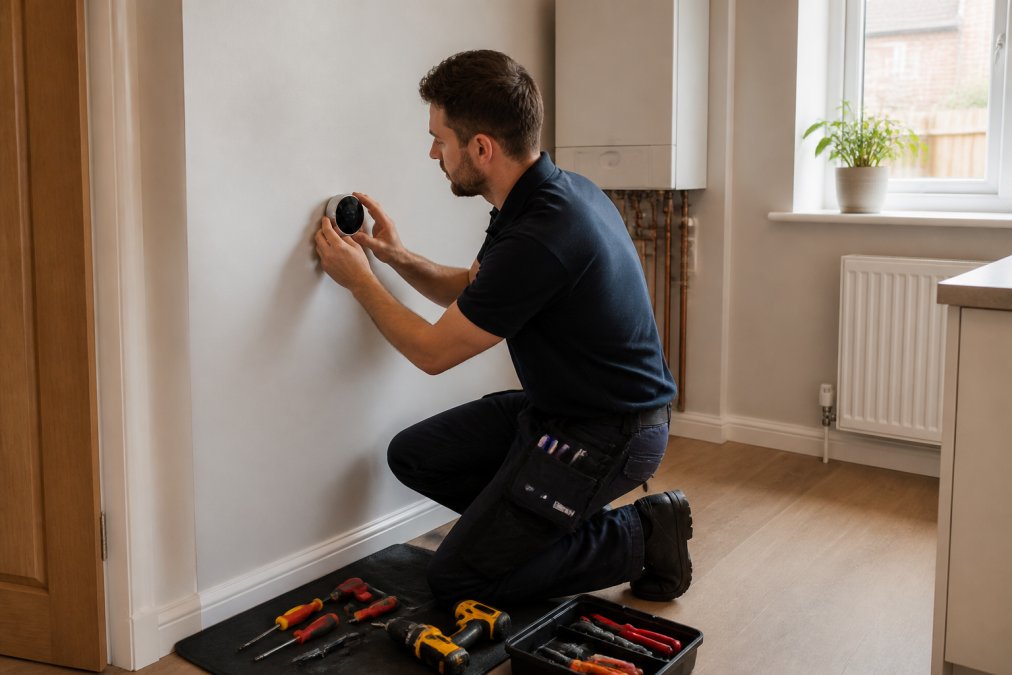
Here is how a typical visit runs.
- Arrival and check. The engineer confirms the boiler, reviews your existing controls, and agrees the mounting position with you.
- Isolation. Power to the heating system is switched off before any wiring is touched.
- Removal and mounting. The old thermostat comes off, the new backplate goes on, and the unit is fixed in place.
- Wiring and connection. The control is wired to the boiler or connected wirelessly, depending on the model.
- Configuration. The engineer sets up the app, connects it to your Wi-Fi, and configures the schedule with you.
- Testing. The boiler is fired and the system checked to confirm the thermostat commands it correctly.
Expect to spend ten minutes at the end learning the app. The engineer should walk you through scheduling, away modes, and how to override the system manually if the internet drops.
The installation itself is quick. The value is in the configuration and testing at the end, so make sure the engineer does not leave until you are confident using the controls.
Choosing the Right Smart Thermostat for Your Maidstone Home
Choosing the right unit comes down to four questions, and answering them honestly will narrow the field fast.
- What boiler do you have? Confirm compatibility before you buy, not after.
- How regular is your routine? Predictable weeks suit programmable models; chaotic ones suit learning thermostats.
- How big is the home? Multiple floors or cold rooms point toward zoning.
- Do you want app control only, or voice control too? Most modern units support both, but check before committing.
For most households in the area, the sensible path is a programmable smart thermostat fitted by a registered engineer, with zoning added only if the home genuinely needs it. Resist the urge to buy the flagship model. The extra features rarely justify the extra cost for a typical semi-detached house.
This is where a proper compatibility check pays for itself. It tells you which models will work with your boiler before you spend anything, and it stops you buying a unit that needs rewiring you did not budget for.
If you are unsure where to start, Major Heat offers free quotes and will assess your boiler and wiring before recommending anything. No pressure, no guesswork.
Heating a home efficiently is not about buying the most expensive control on the shelf. It is about matching the right thermostat to your boiler, your wiring, and how your household actually lives, then having it fitted by someone legally qualified to do the work. Major Heat handles the whole process, from the boiler compatibility check through to installation and setup, with Gas Safe registered engineers, transparent pricing, and free quotes before you commit. Get started with Major Heat and take control of your heating without the guesswork.
Frequently Asked Questions
Can any boiler be upgraded to a smart thermostat?
Most modern boilers work with smart thermostats, but older systems may need additional wiring or a compatibility check. A Gas Safe registered heating engineer can assess your boiler and confirm whether it supports smart controls. If your boiler lacks the necessary connections, they may recommend a relay or adapter. In some cases, upgrading the boiler itself might be more cost-effective than adapting an old system.
Do I need a Gas Safe engineer to install a smart thermostat?
If the installation involves working on the boiler or gas supply, you must use a Gas Safe registered engineer. Simple thermostat swaps that only involve low-voltage wiring can sometimes be done by a competent DIYer, but any gas-related work is legally restricted. For safety and to avoid invalidating warranties, always check the engineer’s Gas Safe ID card before work begins.
How much energy can I save with a smart thermostat?
Smart thermostats can help reduce heating bills, though savings depend on your home’s insulation, heating patterns, and how you use the device. Features like scheduling, geofencing, and learning algorithms prevent unnecessary heating, but actual results vary.
Are smart thermostats compatible with older heating systems?
Many older heating systems can work with smart thermostats, but they may require a boiler compatibility check. Systems with separate hot water tanks and zone valves often need additional wiring or a different thermostat model. A Gas Safe registered heating engineer can advise whether your existing setup supports smart controls or if upgrades are needed.