
Table of Contents
- Why Checking a Gas Safe Registration Matters Before Any Work Starts
- The Importance of Gas Safe Registration for Home Safety
- What the Law Requires of Anyone Working on Gas
- What You’ll Need Before You Start Checking
- Step 1: Find the Engineer on the Gas Safe Register Website
- Step 2: Check the Gas Safe ID Card Features
- Step 3: Match the Registration Number to the Engineer on Site
- How to Report Illegal Gas Work Safely
- Common Mistakes People Make When Verifying an Engineer
- Frequently Asked Questions
Last Updated: September 11, 2026
Why Checking a Gas Safe Registration Matters Before Any Work Starts
Knowing how to verify gas safe registration takes about two minutes, and it is the single most important check you can make before letting anyone touch your boiler, hob, or gas fire. Every gas appliance in your home carries real risk when handled by someone unqualified, and the consequences are not abstract.
This guide from Major Heat walks through the exact process: where to look, what to compare, and what to do if something does not add up. Below, we will show you exactly how to verify gas safe registration in three steps, using the official register and the engineer’s ID card.
The Gas Safe Register is the official list of engineers legally permitted to work on gas appliances in the UK. It replaced CORGI in 2009, and it is the only register that matters.
Letting an unregistered person work on a gas appliance is not just risky, it is illegal. It can also void your home insurance if a fire or carbon monoxide incident is later traced to unqualified work.
The Importance of Gas Safe Registration for Home Safety
Gas Safe registration exists because gas work done badly kills people. Carbon monoxide leaks, faulty flues, and incorrect pipework are not visible problems, and they do not announce themselves until someone becomes unwell.
A registered engineer has proven their competence across the specific type of work they carry out, whether that is boiler installation, servicing, or repair. Registration is not a one-off qualification either. Engineers must renew it and stay current with safety standards.
Many homeowners assume any tradesperson advertising “gas services” is qualified. That assumption is the root of most problems.
What the Law Requires of Anyone Working on Gas
Anyone carrying out gas work in a home must be on the Gas Safe Register. There is no legal alternative, no “experienced but unregistered” exemption, and no valid reason for an engineer to refuse to show their card.
Landlords carry an additional duty. They must arrange an annual gas safety check on every appliance and flue in a rented property, carried out by a registered engineer, and provide tenants with a copy of the record. This is enforced under the Gas Safety (Installation and Use) Regulations, and the Health and Safety Executive’s gas safety guidance sets out what landlords and engineers are required to do.
If you are renting out a property and your current engineer cannot produce a valid registration, you are the one exposed to enforcement action, not them.
What You’ll Need Before You Start Checking
Verification is quick, but gathering the right details first saves you a second trip. Have these ready:
- The engineer’s full name as it appears on their ID card
- Their Gas Safe registration number, a seven-digit figure printed on the front of the card
- The type of work you need done, such as a boiler service, a repair, or a full installation
- Your postcode, in case you check the engineer through the register’s search rather than the card
If an engineer cannot or will not give you their registration number before starting, that is your answer. Stop there.
Step 1: Find the Engineer on the Gas Safe Register Website
Go directly to the official Gas Safe Register website and use the “Check an engineer” search. You can search by registration number, by business name, or by engineer name and location.
Enter the registration number if you have it, because that is the fastest and most reliable route. Searching by name alone can return multiple matches, and you want to be certain you are looking at the right person.
The result page confirms whether the registration is currently valid, which is the detail that matters most. An engineer whose registration has lapsed will still appear in some searches, so read the status carefully rather than just confirming a name appears.
Gas Safe Register’s official engineer check tool
Step 2: Check the Gas Safe ID Card Features
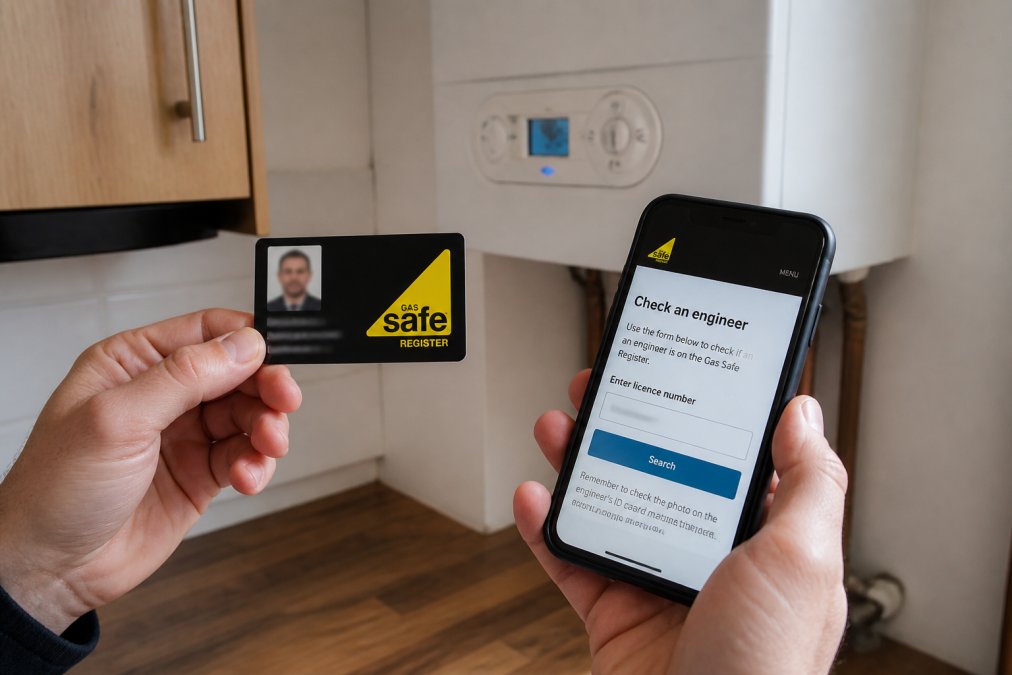
A legitimate Gas Safe ID card carries a photo of the engineer, their registration number, an expiry date, and a holographic logo. Compare the photo to the person standing in front of you, and check that the expiry date has not passed.
Ask to hold the card rather than glancing at it from a distance. Cards are small, and the details that matter, particularly the expiry date and the list of work types, are easy to miss at arm’s length.
What Each Part of the Card Tells You
The card is not just identification. Each element answers a specific question:
| Card Element | What It Confirms |
|---|---|
| Photo | The card belongs to the person on site |
| Registration number | Matches the entry on the official register |
| Expiry date | The engineer’s registration is currently valid |
| Work type list | Which gas work the engineer is qualified to carry out |
| Holographic logo | The card is genuine and not a copy |
The work type list is the element most people overlook, and it is often the most useful. An engineer may be registered for boiler servicing but not for installing a new appliance, or qualified on natural gas but not on LPG. If the list does not cover your job, the registration does not cover it either.
Photograph the card on your phone before work begins. If a problem emerges later, you have the registration number, the expiry date, and the engineer’s details recorded in seconds.
Step 3: Match the Registration Number to the Engineer on Site
The number on the card must match the number that appeared in your register search, digit for digit. If they differ, do not proceed, regardless of how the engineer explains it.
This step catches the most common fraud: an unregistered person borrowing a registered colleague’s card. The photo check usually exposes it, but the number check confirms it.
A legitimate engineer will not be offended by the request. Major Heat’s engineers are Gas Safe registered and expect this check as part of normal practice, because it protects the homeowner and the trade alike.
How to Report Illegal Gas Work Safely
Reporting illegal gas work is straightforward, and you can do it anonymously if you prefer. Contact the Gas Safe Register directly and provide as much detail as you can: the address where the work took place, the name of the person who carried it out, the date, and any photos or paperwork you hold.
Do not confront the person who did the work, particularly if they are still on site or have access to your property. Report it and let the register investigate.
If you believe there is an immediate danger, such as a suspected gas leak or a smell of gas, leave the property and call the National Gas Emergency Service on 0800 111 999. Do not wait to gather evidence first.
Gas Safe Register’s reporting service for illegal gas work
Common Mistakes People Make When Verifying an Engineer
The most frequent error is checking the business rather than the individual. A company can hold registration while the person sent to your door is not registered, or is registered for different work types. Always check the person, not just the firm.
A second mistake is accepting a verbal registration number. Numbers are easy to state and easy to get wrong. Ask to see the card, and compare the printed number against the register yourself.
A third is skipping verification because the engineer came recommended. Word of mouth is a reasonable starting point, but registration status changes, and a recommendation from two years ago tells you nothing about today.
Verification takes two minutes and covers three things: the engineer appears on the official register, the ID card matches that person, and the work type list covers your job. Miss any one of the three and the check is incomplete.
Gas safety is one area where a shortcut is never worth taking, and the two-minute check above is the difference between work that is legal and safe and work that puts your household at risk. At Major Heat, our engineers are Gas Safe registered, we provide free quotes before any work begins, and we handle everything from routine annual servicing to emergency repairs and full boiler installations. Get started with Major Heat and book your next service with an engineer whose registration you can verify before they arrive.
Frequently Asked Questions
How do I check if a gas engineer is Gas Safe registered?
Ask for the engineer’s Gas Safe registration number, then search it on the Gas Safe Register website or call the helpline. The register shows the engineer’s name, business and which gas work types they are qualified for. When they arrive, ask to see their ID card and match the photo, name and number to the register entry. If anything does not match, do not let them start work on your boiler or gas appliances.
What information do I need to verify a Gas Safe engineer?
You need the engineer’s full name, their Gas Safe registration number, and the business name they work for. The registration number is the quickest way to search. On the ID card, check the photo, the licence number, the expiry date and the list of gas work types they are qualified to carry out. If an engineer cannot provide a registration number, treat that as a warning sign and do not allow the work to proceed.
Is it a legal requirement for gas engineers to be Gas Safe registered?
Yes. Anyone carrying out gas work in the UK must be on the Gas Safe Register. Working on gas without registration is illegal and can lead to fines, prosecution and serious safety risks including carbon monoxide leaks. Landlords also have legal duties, including an annual gas safety check on every appliance and flue, carried out by a registered engineer. Always verify registration before any gas work begins on your property.
How do I report an unregistered gas engineer or illegal gas work?
Contact the Gas Safe Register to report anyone carrying out gas work without registration. Provide the engineer’s name, business details, the address where the work took place and any evidence you have, such as photos or paperwork. If you believe there is an immediate danger, call the National Gas Emergency Service on 0800 111 999. Reporting helps protect other households and can lead to enforcement action against the individual.