
Table of Contents
- How Power Flushing Works and Where the Savings Come From
- Signs Your Heating System Needs a Power Flush
- The Cost of Power Flush for Central Heating
- How Long Does a Power Flush Take?
- Factors That Determine Whether Power Flushing Saves You Money
- When Power Flushing Is Not the Right Answer
- Frequently Asked Questions
Last Updated: September 10, 2026
How Power Flushing Works and Where the Savings Come From
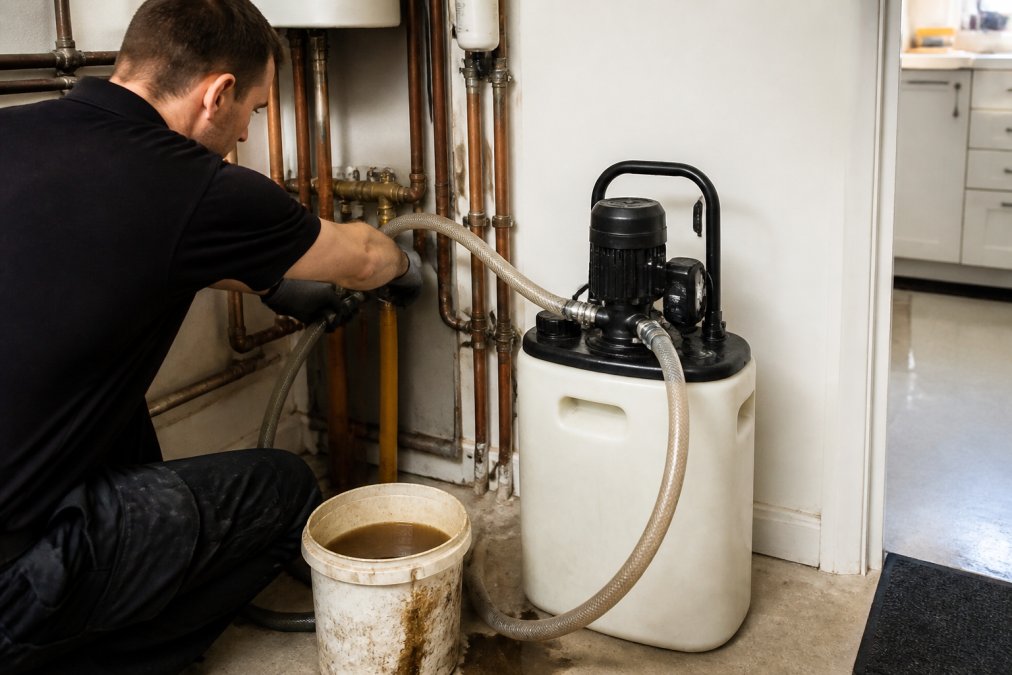
Power flushing is a cleaning process that removes rust, sludge and limescale from a central heating system by circulating water and cleaning chemicals through the pipework at high velocity. The savings come from improved heat transfer: a clean system moves heat from the boiler to the radiators more efficiently, so the boiler runs for shorter periods to reach the same temperature.
Here’s the part most guides skip. Your boiler might be working perfectly, yet still costing you more than it should. Sludge settles at the bottom of radiators and inside pipework, insulating the water from the metal surface it needs to heat. The boiler fires longer, burns more gas, and the rooms still feel cool.
On older systems, a boiler might pass its safety check with no faults, yet radiators are cold at the bottom and warm at the top. That pattern is often a tell-tale sign of circulation problems rather than a boiler fault.
The gains are real but conditional. A well-maintained system that’s flushed unnecessarily will show almost no difference in running costs. A neglected system with visible sludge can see noticeably better heat-up times and more even room temperatures, which is where the money question actually gets answered.
Signs Your Heating System Needs a Power Flush
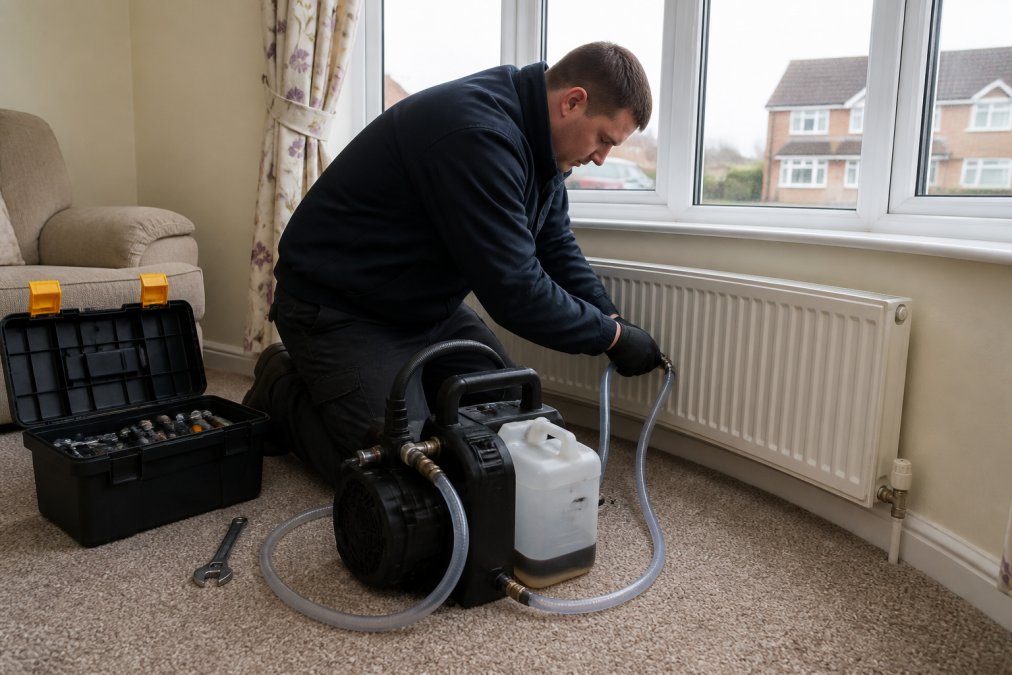
The clearest sign your heating system needs a power flush is radiators that heat unevenly: hot at the top, cold at the bottom. Other indicators include a noisy boiler, black water when you bleed a radiator, and rooms that take far longer to warm than they used to.
Watch for these specific symptoms:
- Radiators cold at the bottom but warm at the top
- A gurgling, kettling or banging noise from the boiler
- Dirty black or brown water when bleeding radiators
- Some radiators heating faster than others in the same property
- The boiler short-cycling: firing up, cutting out, then firing again
- Higher gas usage without any change in how you use the heating
One symptom alone rarely justifies the work. Two or three together, on a system more than eight to ten years old, usually do. A common mistake is booking a power flush purely because a radiator is cold, when the actual cause is trapped air or a faulty thermostatic valve, both far cheaper to fix.
Don’t let anyone sell you a power flush before they’ve inspected the system. A cold radiator can mean trapped air, a seized valve or a balancing issue. Flushing first and diagnosing later is how homeowners pay for work they never needed.
The Cost of Power Flush for Central Heating
The cost of power flush for central heating depends on the number of radiators, the age and layout of the system, and how much sludge has built up. Larger properties with more radiators, or systems with hard water and years of neglect, take longer and cost more.
Pricing isn’t a fixed figure, and any engineer quoting a flat rate over the phone without seeing the system is guessing. What drives the number:
- Radiator count: more radiators means more flushing time and more chemical
- System age and condition: heavily sludged systems need longer circulation and possibly repeat treatment
- Access and layout: pipework hidden behind floors or boxing slows the job
- Added work: a chemical inhibitor dose and a magnetic filter are often recommended alongside the flush
We provide free quotes so you know the figure before any work begins, with no vague estimates that shift once the hoses are connected. If you want a realistic number for your property, the only reliable route is a proper assessment of your system.
Gas Safe Register’s guidance on finding and checking a registered engineer is worth reading before you book anyone, because the engineer working on your gas appliance must be on the register by law.
How Long Does a Power Flush Take?
A power flush typically takes between four and eight hours for an average home, though larger or heavily contaminated systems can run into a full day (energysavingtrust.org.uk). The work isn’t a quick visit, and anyone promising a two-hour job on a sludged system isn’t doing it properly.
Time breaks down roughly like this:
| System Type | Typical Duration | What Affects It |
|---|---|---|
| Small flat, 4-6 radiators | 4-5 hours | Minimal pipework, light sludge |
| Average home, 7-10 radiators | 5-7 hours | Radiator count, access |
| Large home, 10+ radiators | 7-10 hours | System size, sludge volume |
| Heavily sludged system | Full day or more | Years of neglect, repeat flushing |
The process itself involves connecting a pump to the system, circulating cleaning chemicals, reversing the flow to dislodge deposits, then flushing with clean water until it runs clear. After that, an inhibitor goes in to slow future corrosion. Skipping the inhibitor is a false economy: without it, sludge returns faster than it left.
Factors That Determine Whether Power Flushing Saves You Money
Whether power flushing saves you money comes down to four factors: how much sludge is present, the age and efficiency of the boiler, how long you plan to stay in the property, and whether the system has other faults.
A system with genuine sludge buildup and an otherwise healthy boiler is the best-case scenario. Heat reaches the radiators faster, the boiler runs less, and the improvement is noticeable in both comfort and consumption. A system with a failing boiler won’t be rescued by a flush; the money is better spent toward replacement.
- Sludge severity: heavy buildup means bigger gains; a clean system means little to none
- Boiler condition: flushing helps a working boiler, not a dying one
- Timeframe: the longer you stay, the more time the savings have to accumulate
- Water quality: hard water areas see faster scale and sludge buildup
- Existing faults: a flush won’t fix a broken valve or a leaking pipe
The honest answer is that power flushing pays back over years, not weeks. Treat it as maintenance that protects efficiency and extends the life of the system, not as a quick fix that slashes your next bill.
Ask for a magnetic filter to be fitted at the same time. It captures the iron particles that cause sludge in the first place, so the system stays cleaner for longer and you’re not repeating the flush in three years.
When Power Flushing Is Not the Right Answer
Power flushing is not the right answer when the boiler itself is old and inefficient, when the radiators are cold because of a single faulty component, or when the system is already clean. In those cases, you’re paying for work that won’t change your bills.
An ageing boiler that’s 12 years old and struggling is a replacement conversation, not a flushing one. No amount of cleaning makes a worn heat exchanger efficient again. Similarly, if one radiator is cold and the rest are fine, the problem is local: a stuck valve, trapped air or a balancing issue, all quick and cheap to resolve.
There’s also a maintenance alternative. A chemical clean or a magnetic filter fitted on its own can hold a mildly sludged system steady at lower cost, which suits homeowners not ready for a full flush. The right call depends on how bad things actually are, and that requires an engineer to look rather than guess.
Energy Saving Trust guidance on heating your home efficiently makes the broader point well: keeping a system well-maintained and correctly controlled matters more for running costs than any single intervention.
A heating system that’s quietly losing efficiency is one of the easiest problems to miss, because nothing breaks and nothing warns you. If your radiators heat unevenly, your boiler kettles, or your bills have crept up without explanation, it’s worth having the system properly assessed before deciding whether a flush is the answer. Major Heat’s Gas Safe registered engineers install, service and repair boilers, provide free quotes, and handle emergency call-outs when a system fails without warning. Get started with Major Heat and find out exactly what your heating system needs, with transparent pricing and no guesswork.
Frequently Asked Questions
How much money can a power flush save on heating bills?
Savings depend on how much sludge is restricting your system. A heavily contaminated system can use noticeably more gas to reach the same temperature, so removing that build-up may reduce consumption. There is no guaranteed percentage, but if your radiators have cold spots at the bottom and your boiler short-cycles, a power flush can restore even heat distribution and cut wasted energy. For a precise figure, ask a Gas Safe registered engineer to assess your system first.
How do I know if my central heating system needs a power flush?
Common signs include radiators that are cold at the bottom but warm at the top, a noisy boiler or pump, black water when you bleed a radiator, and uneven heating between upstairs and downstairs. If your system takes longer to warm up than it used to, sludge may be the cause. A heating engineer can confirm with a water sample or by checking flow rates.
Is a power flush necessary when installing a new boiler?
Many boiler manufacturers require a clean system for the warranty to remain valid. If your existing system has sludge, installing a new boiler without flushing can carry that debris into the new heat exchanger, causing blockages and premature failure. A power flush before installation protects your investment and is often specified in the installation instructions.
Does power flushing damage older radiators?
A power flush can reveal existing weaknesses in old radiators that were already corroded. If a radiator is severely corroded, the flushing process may cause it to leak. A Gas Safe registered engineer will assess your system beforehand and advise if any radiators need replacing first. For most systems in reasonable condition, power flushing is safe and restores efficiency.