Table of Contents
- What Happens When a Gas Safety Check Fails
- At Risk vs Immediately Dangerous Gas Appliances
- Your Immediate Steps After a Failed Gas Safety Check
- Who Is Responsible for Repairs After a Failed Gas Safety Check
- How to Report a Landlord for No Gas Safety Certificate
- The Cost of a Gas Safety Check and Repair Work
- Finding a Gas Safe Registered Engineer
- Frequently Asked Questions
Last Updated: September 14, 2026
What Happens When a Gas Safety Check Fails
A failed gas safety check means your appliance has been classified as either At Risk or Immediately Dangerous, and the engineer is legally required to act. This guide from Major Heat explains exactly what happens next, what you must do, and who pays for the repair.
Under the Gas Safety (Installation and Use) Regulations 1998, a Gas Safe registered engineer who identifies a dangerous appliance cannot simply note it and leave. They must notify you in writing, and for the most serious cases, they must take action to prevent the appliance being used until it is made safe. That legal duty is the starting point for everything that follows.
What most people don’t realise is that a failed check isn’t a single outcome. It’s a classification, and the classification determines how urgent the situation is and what your engineer is obliged to do about it. Understanding the difference between the two categories is the first thing to get straight.
The Engineer’s Duty to Notify
The engineer’s duty to notify is a legal obligation, not a courtesy. If your appliance fails, the engineer must give you a written warning notice explaining the fault and the classification.
For an Immediately Dangerous appliance, the engineer must also take steps to make it safe. In practice, that usually means disconnecting the appliance, capping the gas supply to it, or attaching a warning label that must not be removed. They will ask you to sign to confirm you’ve received the notice. If you refuse, they can still act to isolate the appliance, because the law prioritises safety over consent.
This isn’t the engineer being difficult. The Gas Safe Register’s guidance for consumers is clear that registered engineers face prosecution if they leave a known dangerous appliance in operation. A common mistake is arguing with the engineer at this point. Don’t. The classification isn’t a negotiating position, and the engineer has no discretion to ignore it.
At Risk vs Immediately Dangerous Gas Appliances
The difference between At Risk and Immediately Dangerous comes down to how likely the appliance is to cause harm right now. At Risk means there’s a fault that could become dangerous if left, while Immediately Dangerous means a genuine and present threat to life.
An At Risk classification describes an appliance with a defect that could become hazardous, such as a faulty flue that isn’t yet leaking combustion products into the room, or poor ventilation that could deteriorate further. You’ll be advised to stop using it until it’s repaired, but the engineer won’t necessarily disconnect it.
An Immediately Dangerous classification describes an appliance that poses a real and immediate threat, such as a significant gas leak, a carbon monoxide leak, or a flue that is actively spilling combustion products into the living space. The engineer must act to make it safe before leaving.
What Each Classification Means for You
| Classification | Threat Level | Engineer’s Action | Your Next Step |
|---|---|---|---|
| At Risk | Potential hazard if left | Written notice, advice to stop using | Arrange repair before further use |
| Immediately Dangerous | Present threat to life | Written notice plus isolation or disconnection | Do not use; arrange urgent repair or replacement |
For an At Risk appliance, you have a little breathing room, but not much. Get it repaired before you use it again. For an Immediately Dangerous appliance, treat it as an emergency: ventilate the room, avoid operating gas or electrical switches if you smell gas, and arrange an urgent visit.
Your Immediate Steps After a Failed Gas Safety Check
Your immediate steps after a failed gas safety check are straightforward: stop using the affected appliance, keep the written notice safe, and book a qualified repair. Don’t attempt to restart an isolated appliance yourself.
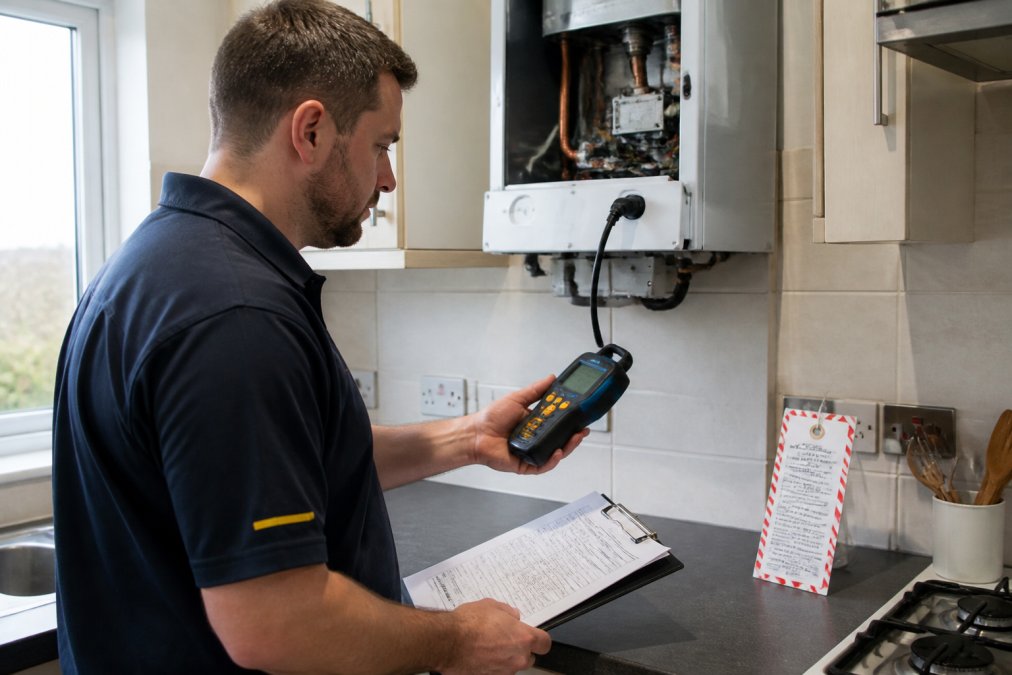
Work through this in order:
- Stop using the appliance immediately, whether it’s At Risk or Immediately Dangerous
- If you smell gas, open windows and doors, avoid using switches, and call the National Gas Emergency Service on 0800 111 999
- Keep the written warning notice; your landlord or insurer may ask for it
- Do not remove any warning label or reconnect a capped appliance
- Book a Gas Safe registered engineer to assess and repair the fault
- If you’re a tenant, tell your landlord in writing straight away
Never reconnect an appliance the engineer has isolated, even if it seems to work. Doing so risks carbon monoxide poisoning and voids any insurance cover. Only a Gas Safe registered engineer can legally reconnect it.
Who Is Responsible for Repairs After a Failed Gas Safety Check
Responsibility for repairs depends on whether you own or rent the property. Homeowners pay for and arrange repairs themselves; landlords are legally responsible for repairs and for any gas safety check on appliances they provide.
If you own your home, the appliance is your responsibility. You’ll need to arrange and pay for the repair, and you should not use the appliance until a registered engineer has confirmed it’s safe.
If you rent, your landlord is responsible for maintaining the appliance and for arranging the annual gas safety check. Under the Gas Safety (Installation and Use) Regulations 1998, landlords must have every gas appliance they provide checked every 12 months by a Gas Safe registered engineer and give tenants a copy of the record. If a check fails, the landlord must carry out the repair. As a tenant, you should report the fault in writing so there’s a clear record of when you raised it.
For landlords, Major Heat handles landlord safety certificates and compliance checks.
How to Report a Landlord for No Gas Safety Certificate
Reporting a landlord for no gas safety certificate starts with a written request to your landlord for a copy of the current record. If they don’t provide it, you can escalate to the Health and Safety Executive (HSE), which enforces gas safety law.
The process is less intimidating than it sounds:
- Ask your landlord in writing for a copy of the gas safety record. Keep a dated copy of your request.
- If nothing arrives, contact the Health and Safety Executive’s gas safety guidance for advice on enforcement.
- Your local authority’s environmental health team can also advise on housing standards.
- If the landlord still fails to act, the HSE can issue enforcement notices and, in serious cases, prosecute.
A common mistake is relying on a verbal request. Put everything in writing and keep the dates. If the matter escalates, a clear paper trail is what gets action.
The Cost of a Gas Safety Check and Repair Work
The cost of a gas safety check and any follow-up repair depends on the appliance, the fault, and the engineer. Pricing depends on the specific job, and a quote will be provided after assessment.
A routine gas safety check on a single appliance is generally the smaller part of the bill. The repair is where costs vary, because a simple fix such as a replacement part is a different job from a full appliance replacement. Factors that move the price include the age and type of the appliance, whether parts are readily available, and whether the fault is isolated or part of a wider system problem.
At Major Heat, we give free quotes so you know the price before work begins. If you’re weighing up repair versus replacement on an older boiler, a registered engineer can talk you through both options.
Finding a Gas Safe Registered Engineer
Finding a Gas Safe registered engineer means checking the official register, not taking a recommendation at face value. Every engineer legally permitted to work on gas in the UK carries a Gas Safe ID card, and you can verify it in minutes.
To check an engineer:
- Ask to see their Gas Safe ID card before any work begins
- Check the card’s photo, licence number, and expiry date
- Confirm the card lists the type of work you need, such as boilers or cookers
- Verify the details on the Gas Safe Register’s official website
The thing nobody tells you about the register is that registration covers specific work types, not gas work in general. An engineer registered for cookers isn’t automatically registered for boilers. Check the back of the card for the exact scope.
Major Heat’s engineers are Gas Safe registered, and we cover installations, servicing, repairs, and emergency plumbing across the area. Our emergency service aims to provide reliable assistance.
Frequently Asked Questions
What happens if a boiler fails a gas safety check?
The engineer will classify the fault as At Risk or Immediately Dangerous. For Immediately Dangerous, they must turn off the appliance and cap the gas supply to it, and you cannot use it until repairs are done. For At Risk, you can still use the appliance but only under strict conditions, and you should arrange repairs quickly. The engineer will give you a warning notice explaining the fault and what needs to happen next. A failed gas safety check is not the end of the world, but it does require prompt action to keep everyone safe.
Can I still use my boiler if it fails a gas safety inspection?
It depends on the classification. If the engineer marks the appliance as Immediately Dangerous, you cannot use it. They will disconnect it and attach a warning label. Using it would be illegal and unsafe. If it is At Risk, you may be able to use it for a short period while you arrange repairs, but you should follow the engineer’s advice and get it fixed as soon as possible. Never ignore a warning notice. If you are unsure, call a Gas Safe registered engineer for guidance before turning anything back on.
How long do I have to fix a gas safety issue?
There is no fixed legal deadline, but you must act without delay. For Immediately Dangerous appliances, you cannot use them until they are repaired and pass a new check. For At Risk appliances, you should arrange repairs within days, not weeks. Landlords must ensure all gas appliances and flues are safe before the next tenancy or within 12 months of the last check. If you delay repairs and someone is harmed, you could face fines or prosecution. The safest approach is to book a repair as soon as the engineer identifies the fault.
How do I report a landlord for not providing a gas safety certificate?
You can report your landlord to the Health and Safety Executive (HSE) or your local council’s environmental health department. The HSE provides an online form for reporting gas safety concerns. Before reporting, gather evidence such as your tenancy agreement, any communication with your landlord, and dates. Landlords must give you a copy of the gas safety certificate within 28 days of the check and before you move in. If they fail to do so, they are breaking the law and could be fined. Reporting is confidential and helps keep you and other tenants safe.
A failed gas safety check is stressful, but the path forward is clear: stop using the appliance, keep the paperwork, and get a registered engineer to fix it properly. Major Heat’s Gas Safe registered engineers handle boiler installations, servicing, repairs, and emergency call-outs, with transparent pricing and free quotes so there are no surprises. Get started with Major Heat and put your heating system back in safe, reliable hands.