
Table of Contents
- What You’ll Need Before Water Heater Installation Begins
- Step 1: Isolate Power and Water Supplies Safely
- Step 2: Remove the Old Unit and Check the Mounting Point
- Step 3: Fit the New Water Heater and Connect Pipework
- Step 4: Commission the System and Check for Leaks
- Why You Need a Gas Safe Registered Engineer for the Gas Work
- G3 Building Regulations Compliance for Water Heater Installation
- Common Mistakes to Avoid During Water Heater Installation
- Frequently Asked Questions
Last Updated: September 27, 2026
What You’ll Need Before Water Heater Installation Begins
Water heater and installation work starts long before anyone picks up a wrench. Getting the preparation right is what separates a two-hour job from a two-day nightmare, and it is the step most homeowners underestimate.
Getting the preparation right is what separates a two-hour job from a two-day nightmare, and it is the step most homeowners underestimate. Here’s what you need in place first:
- A replacement unit that matches your current fuel type and physical space
- Building Regulations approval where required for the work
- Isolation valves for both water and gas or power supplies
- A suitable mounting point that can carry the full weight of a filled cylinder
- Buckets, towels, and a wet vacuum for the inevitable spillage
- Gas Safe registration documents if any gas work is involved
The water heater and installation process also needs one more thing: a clear plan for what happens to the old unit. Most councils classify old cylinders as scrap metal, and your installer should tell you how they’ll remove it. Ask before the day of the job, not after.
Never attempt to move or disconnect a gas-fed water heater yourself. In the UK, any work on gas appliances must be carried out by a Gas Safe registered engineer. Getting this wrong risks carbon monoxide exposure and is a criminal offence.
Step 1: Isolate Power and Water Supplies Safely
The single most important safety step is full isolation. Before anything is touched, both the energy supply and the water supply to the unit must be completely shut off and proven dead.
For a gas water heater, that means closing the gas isolation valve and confirming the supply is off. For an electric immersion or unvented cylinder, you need to switch off the circuit at the consumer unit and lock it out so nobody can restore power while you’re working.
Next, close the cold water inlet valve feeding the cylinder. Then open the lowest hot tap in the property to drain the system down and release pressure. Water will keep flowing for a few minutes, so have buckets ready.
A common mistake is assuming the isolation valve actually works. Older gate valves seize open. Test it by opening a hot tap and watching whether the flow stops. If it doesn’t, you need to isolate at the mains instead.
Step 2: Remove the Old Unit and Check the Mounting Point
Draining and removing the old cylinder comes next. Once the system is empty, disconnect the pipework in a logical order, usually starting with the lowest connections, and have a container ready for the last litre or two that always seems to hide in the base.
Old units are heavier than they look, especially a cylinder that still holds sludge. Two people minimum for lifting, and a trolley if you have stairs.
This is also the moment to inspect the mounting point properly. Look for:
- Water staining or rust around the old fixings
- Soft or crumbling plasterboard behind the unit
- Any sign the previous cylinder was undersupported
- Corrosion on pipework that will be reused
If the wall or floor can’t take the weight, you need to reinforce it before fitting anything new. Skipping this check is how units end up sagging or, worse, falling.
Step 3: Fit the New Water Heater and Connect Pipework
Positioning and connecting the new unit is where precision matters most. The cylinder must sit level, be secured to a sound mounting point, and have every connection made with the correct fittings and jointing method for the pipe material.
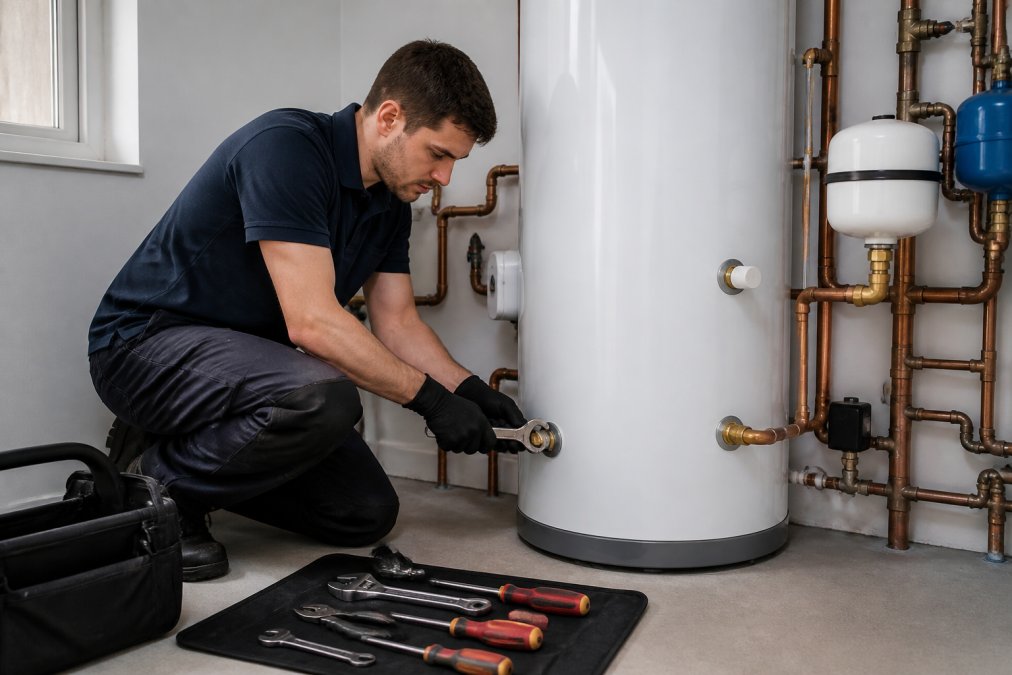
Work through the connections methodically:
- Secure the cylinder to the mounting point first, never after pipework
- Connect the cold inlet, then the hot outlet, using the correct compression or push-fit fittings
- Fit a pressure relief valve where the system requires one
- Insulate exposed pipe runs to reduce heat loss
- Leave the gas connection to a Gas Safe registered engineer
Pipework alignment matters more than speed. Forcing a joint to fit stresses the seal and it will leak. If a pipe doesn’t line up, adjust the run rather than the fitting.
Step 4: Commission the System and Check for Leaks
Commissioning is the step that proves the job is actually done. Fill the system slowly, bleed every hot outlet in the property, and then check every single joint you touched.
Start by opening the cold inlet and letting the cylinder fill. Open each hot tap in turn, starting with the lowest, until water runs steadily with no sputtering. Sputtering means air is still trapped.
Then run a full leak check:
- Dry every joint with a cloth and watch for fresh moisture
- Check the pressure relief valve isn’t weeping
- Confirm the thermostat is set correctly and the unit heats as expected
- Run a hot tap for several minutes and recheck the joints under heat
Heat changes things. A joint that looks dry when cold can weep once the pipe expands, so always recheck after the system has run hot for a while.
Photograph every joint before you close up any boxing or panels. If a leak appears weeks later, you’ll know exactly where to look without pulling everything apart.
Why You Need a Gas Safe Registered Engineer for the Gas Work
Any gas work on a water heater must be done by a Gas Safe registered engineer. This is a legal requirement under the Gas Safety (Installation and Use) Regulations, and there is no DIY exemption.
You can verify an engineer’s registration through the Gas Safe Register official website by checking their ID card and licence number. Every legitimate engineer carries one, and the card lists exactly which types of gas work they’re qualified to carry out.
This matters for more than paperwork. Unsafe gas work causes carbon monoxide poisoning, which kills people every year in the UK. A registered engineer tests for correct combustion, checks ventilation, and confirms the appliance is safe to use.
For landlords, there’s an added duty. Annual gas safety checks are a legal obligation, and a registered engineer must carry them out. Major Heat’s Gas Safe registered engineers handle both installations and the compliance checks landlords need, so the paperwork stays in order.
G3 Building Regulations Compliance for Water Heater Installation
G3 Building Regulations compliance applies to the installation of unvented hot water cylinders and covers the safety requirements for storing hot water under pressure. If your new unit is unvented, the work must meet G3 standards.
The rules cover several areas:
- Correctly sized pressure and temperature relief valves
- A discharge pipe that safely routes any release of hot water
- Proper expansion vessel sizing for the system volume
- Installation by a competent person with the right qualifications
Compliance isn’t optional. An unvented cylinder that doesn’t meet G3 can fail a building control inspection, and your home insurance may not cover damage from a non-compliant installation.
Most homeowners don’t need to memorise the regulations.
The two compliance checks that matter most are Gas Safe registration for gas work and G3 competence for unvented cylinders. Confirm both before you book, not after the engineer arrives.
Common Mistakes to Avoid During Water Heater Installation
Most failed installations trace back to a handful of avoidable errors. Knowing them in advance saves money, time, and in the worst cases, a lot of grief.
| Mistake | Why It Happens | The Fix |
|---|---|---|
| Skipping isolation checks | Assuming valves work | Test every valve before draining |
| Undersized mounting point | Reusing old fixings | Reinspect and reinforce the wall |
| Forcing pipe connections | Misaligned pipework | Adjust the run, not the joint |
| Skipping the hot leak check | Checking only when cold | Recheck every joint after heating |
| DIY gas connections | Cost-saving attempt | Use a Gas Safe registered engineer |
| Missing G3 documentation | Not asking upfront | Request compliance paperwork in writing |
Frequently Asked Questions
Do I need a Gas Safe registered engineer to install a water heater?
Yes. Any work on gas appliances, including connecting a gas water heater, must be carried out by a Gas Safe registered engineer. It is a legal requirement under the Gas Safety (Installation and Use) Regulations 1998. You can verify an engineer’s registration by checking their ID card and the Gas Safe Register website. Using an unregistered person is illegal, invalidates your home insurance, and puts you at risk of carbon monoxide poisoning.
How long does a typical water heater installation take?
The duration of a water heater installation can vary significantly. A straightforward replacement of a like-for-like unit might be quicker, while installations requiring changes to pipework, flue routing, or electrical connections, or those involving unvented cylinders and system upgrades, can take longer. Your engineer should give you a realistic time estimate before starting, and you should expect the water and power to be off for most of that period.
What are the building regulations for water heater installations?
In the UK, water heater installations must comply with the Building Regulations. Part G covers sanitation, hot water safety, and water efficiency. If you are installing an unvented hot water cylinder over 15 litres, G3 building regulations compliance is mandatory. This means the cylinder must be fitted by a competent person holding a current G3 qualification, and a Building Regulations compliance certificate must be issued. Part L also applies, covering energy efficiency.
Should I repair or replace my existing water heater?
Deciding whether to repair or replace your water heater often depends on its age, the frequency of repairs, and any signs of corrosion. Newer models are generally more energy-efficient, which can lead to savings on bills. For an honest assessment, it’s best to consult a Gas Safe registered engineer. Major Heat offers free quotes for replacements so you can weigh up your options.
Sorting out a water heater and installation job properly comes down to preparation, compliance, and knowing when to call in a registered engineer. Major Heat’s Gas Safe registered team handles installations, servicing, and repairs across the region, with free quotes and clear pricing before work begins. Get started with Major Heat and get your hot water running safely, with the compliance paperwork to prove it.