Table of Contents
- What Boiler Error Codes Actually Mean
- Boiler Pressure Too Low: The Most Common Cause of Error Codes
- How to Reset a Boiler After an Error Code
- Common Boiler Error Codes and What They Tell You
- When to Call a Gas Safe Registered Engineer
- Repair or Replace? Making the Call on an Older Boiler
- Conclusion
- Frequently Asked Questions
Last Updated: September 16, 2026
What Boiler Error Codes Actually Mean
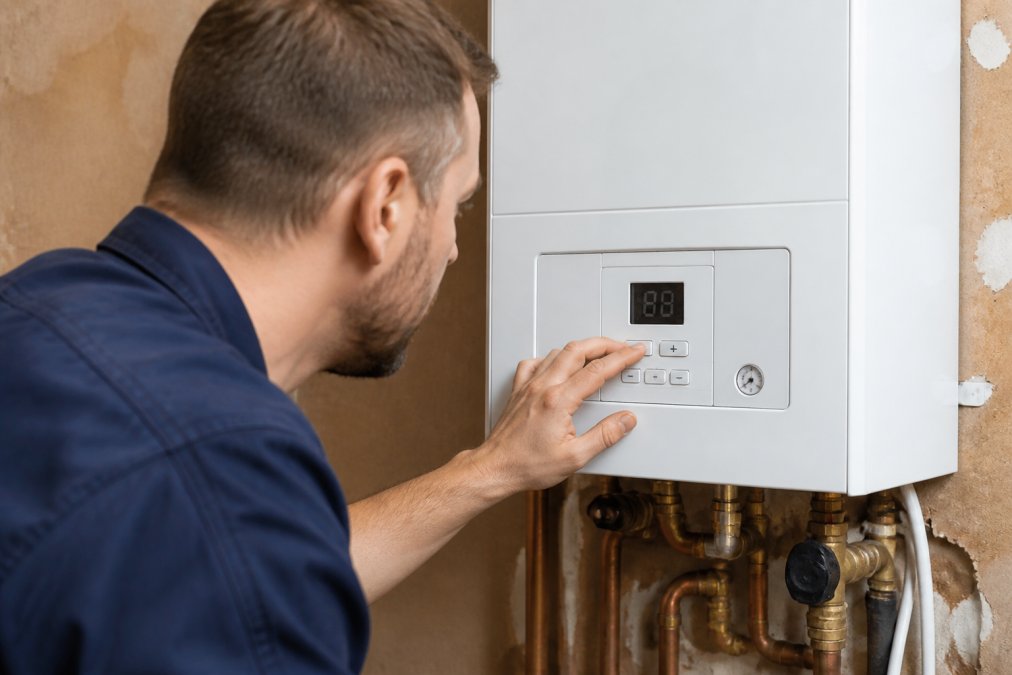
A boiler error code is a diagnostic signal the boiler’s control board displays when it detects a fault, and it is the fastest route to understanding why your heating or hot water has stopped working. At Major Heat, our Gas Safe registered engineers see the same handful of faults behind most call-outs, and knowing how to troubleshoot common boiler error codes can save you a cold night and an unnecessary emergency fee.
Modern boilers run a self-check routine continuously. When a reading falls outside safe parameters, the board locks out and flashes a code rather than risk an unsafe firing sequence.
That is the key point most homeowners miss: the code is not the fault itself. It is the boiler telling you which sensor tripped, so you can work backwards to the cause.
Below, we break down what each family of codes points to, how to reset safely, and the point at which you should stop and call a professional.
An error code tells you which safety check failed, not which part has broken. Treat it as a starting point for diagnosis, never as a confirmed parts list.
Boiler Pressure Too Low: The Most Common Cause of Error Codes
Low pressure is the single most frequent trigger for a boiler lockout, and it usually shows as a fault code paired with a pressure gauge reading below 1 bar. When pressure drops, the boiler’s internal sensors detect insufficient water volume and refuse to fire.
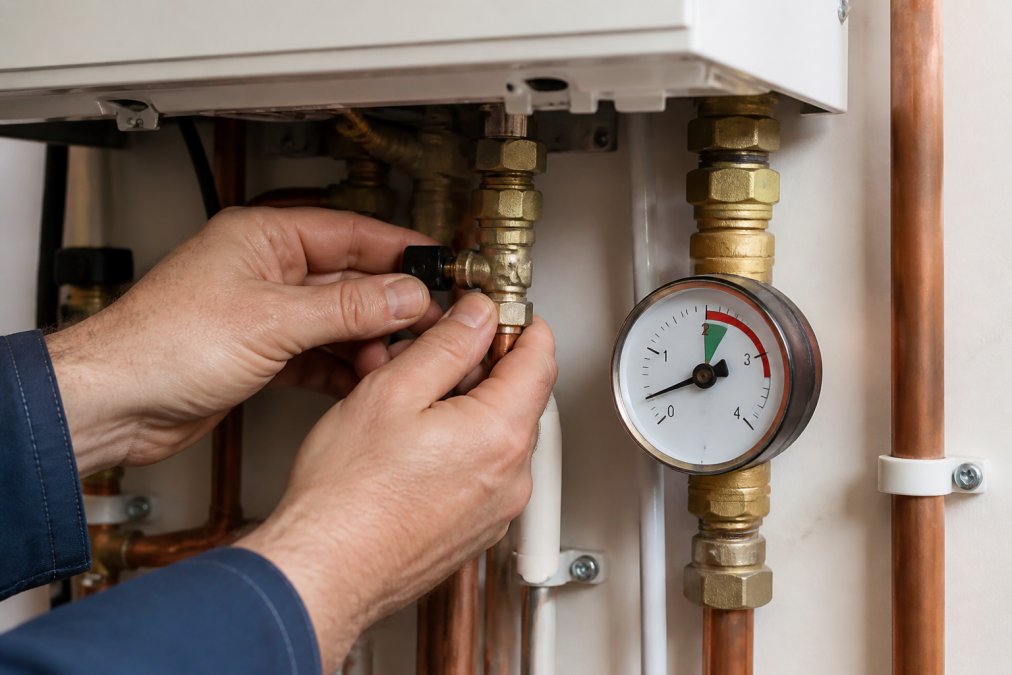
Pressure falls for predictable reasons. A slow leak somewhere in the system, recently bled radiators, or a faulty pressure relief valve all let water escape over time.
Topping up is straightforward on most combi boilers:
- Locate the filling loop, usually a braided hose beneath the boiler with two valves.
- Open both valves slowly and watch the pressure gauge.
- Stop at 1 to 1.5 bar, then close both valves fully.
- Reset the boiler and check whether it fires.
If pressure holds, you have solved it. If it drops again within days, you have a leak, and that is a job for an engineer. A common mistake is overfilling to 2 bar or more, which stresses seals and can cause the relief valve to discharge.
How to Reset a Boiler After an Error Code
Resetting a boiler means clearing the lockout so the boiler can attempt to fire again, and it takes seconds on most models. Find the reset button, usually a clearly marked button on the front panel, hold it for the time stated in your manual, then wait.
The sequence matters more than the button. Turn the thermostat down, wait a few minutes, then reset. If the boiler fires and runs normally, the fault was likely a one-off. If the same code returns immediately, resetting again will not help, and repeated resetting can mask a genuine fault.
Never reset a boiler more than two or three times in a row. If a fault keeps returning, the boiler is telling you something is genuinely wrong, and forcing it to fire can damage components or create a safety risk.
If you smell gas at any point, do not reset anything. Leave the property and call the National Gas Emergency Service on 0800 111 999 immediately.
Common Boiler Error Codes and What They Tell You
Most manufacturer codes fall into three families: pressure faults, ignition faults, and condensate or flue faults. The exact letters and numbers vary between brands, so always check your boiler’s manual for the specific meaning, but the underlying causes are consistent.
| Fault Family | Typical Symptoms | First Checks | Likely Cause |
|---|---|---|---|
| Low pressure | Code plus gauge below 1 bar | Check pressure gauge, top up via filling loop | Leak, recently bled radiators, faulty relief valve |
| Ignition or flame failure | Boiler tries to fire, then locks out | Confirm gas supply, check other gas appliances | Blocked ignition, faulty flame sensor, gas supply issue |
| Condensate or flue | Lockout after running, gurgling sounds | Check condensate pipe for ice or blockages | Frozen or blocked condensate pipe, flue obstruction |
Fault Codes That Usually Mean Low Pressure
Codes in this family appear alongside a pressure reading that has fallen below the safe threshold. Topping up the system via the filling loop resolves most cases, but only if the pressure then holds. If it keeps dropping, the underlying leak needs professional attention.
Fault Codes That Point to Ignition or Flame Failure
These codes mean the boiler attempted to light and failed, or lit and then lost its flame. Check that other gas appliances in the property are working; if they are not, the issue may be your gas supply rather than the boiler. Do not attempt to access or clean ignition components yourself, as this is gas work and legally restricted.
Fault Codes That Indicate a Condensate or Flue Problem
Condensing boilers produce acidic water that drains away through a condensate pipe. In cold weather, this pipe can freeze and block, causing a lockout. Thawing a frozen external condensate pipe with warm water is a safe DIY fix. Any flue-related fault, however, should be left to a Gas Safe registered engineer, as flue integrity is a safety-critical matter.
When to Call a Gas Safe Registered Engineer
You should call a Gas Safe registered engineer whenever a fault involves gas, the flue, or the combustion chamber, or when a code returns after a reset. In the UK, it is a legal requirement that anyone working on gas appliances is on the Gas Safe Register, and you can verify an engineer’s registration on the official register before booking.
The Gas Safe Register’s official engineer check lets you confirm a business’s credentials in minutes. Any legitimate engineer will expect you to check and will not be offended.
Stop and call a professional if:
- You smell gas or suspect a leak
- The same code returns after two resets
- The boiler repeatedly loses pressure
- You see water, soot, or yellow flames
- The fault involves the flue or combustion components
A Gas Safe registered engineer will diagnose the fault properly, carry out any gas work legally, and confirm the appliance is safe to run. For more detail on what the register covers, see Gas Safe Register guidance.
Before booking an emergency call-out, have your boiler’s make, model, and the exact fault code to hand. Engineers can often tell you over the phone whether it is a quick fix or a genuine breakdown, which saves you time and money.
Repair or Replace? Making the Call on an Older Boiler
Repair makes sense when the fault is isolated and the boiler is otherwise sound; replacement becomes the better financial call when faults are recurring or parts are scarce. The decision usually comes down to age, repair frequency, and parts availability rather than a single fault code.
Ask yourself three questions:
- Has the boiler needed more than one repair in the past two years?
- Is it over ten to twelve years old, the point at which efficiency and parts availability typically decline?
- Is the repair cost a significant share of a new installation?
If you answer yes to two or more, replacement is often the more sensible long-term choice. If the boiler is younger and the fault is a one-off, repair is usually the right call. A Gas Safe engineer can give you an honest assessment with a free quote, so you are not guessing.
Conclusion
Boiler error codes are not a mystery, they are a diagnostic language, and once you understand the three main families you can handle the simple fixes yourself and recognise the point where professional help is essential. The line is clear: pressure top-ups and frozen condensate pipes are within reach for most homeowners, while anything involving gas, the flue, or repeated lockouts belongs with a Gas Safe registered engineer.
If you are dealing with a fault you cannot clear, or you want an honest verdict on whether to repair or replace, Major Heat can help.
Frequently Asked Questions
Can I fix a boiler error code myself?
Some boiler error codes have straightforward fixes you can try yourself, such as repressurising the system when the pressure has dropped below 1 bar, or resetting the boiler using the reset button or dial. However, anything involving gas, the flue, or internal components must be handled by a Gas Safe registered engineer. Under the Gas Safety (Installation and Use) Regulations 1998, only registered engineers can legally work on gas appliances, so if a reset does not clear the fault, stop and call a professional.
What does it mean when my boiler shows a fault code?
A fault code is your boiler’s way of telling you what has gone wrong internally. Codes vary by manufacturer, so an F1 on one model may mean something different on another. Most codes fall into a few groups: low pressure, ignition or flame failure, condensate blockage, or overheating. Check your boiler manual or the manufacturer’s website to match the code to its meaning before attempting any fix, and never open the boiler casing yourself.
How do I reset my boiler after an error code?
Locate the reset button, usually on the front panel and marked with a flame symbol or the word ‘reset’. Press and hold it for three to five seconds, then wait a few minutes to see if the boiler fires up again. If the same code returns straight away, do not keep resetting it. Repeated lockouts usually point to a fault that needs a Gas Safe registered engineer to diagnose, and pressing reset over and over can mask a genuine safety issue.
When should I call a Gas Safe registered engineer for a boiler fault?
Call a Gas Safe registered engineer if you smell gas, if the boiler repeatedly locks out after resetting, if you see yellow or orange flames instead of blue, or if the boiler leaks water. You should also call an engineer if your boiler pressure drops below 1 bar every few days, as this suggests a leak in the system. You can verify an engineer’s registration by checking their ID card or using the Gas Safe Register website.