
Table of Contents
- What the Law Requires of Landlords
- The Gas Safety (Installation and Use) Regulations 1998 in Practice
- Your Annual Gas Safety Check: A Landlord’s Checklist
- What a Landlord Gas Safety Certificate Cost Covers
- How Long to Keep Gas Safety Records and Why It Matters
- When Tenants Report a Fault: Your Repair Duties
- Penalties for Getting It Wrong
- Frequently Asked Questions
Last Updated: September 11, 2026
What the Law Requires of Landlords
Landlord responsibilities for gas appliance maintenance are set out in law, and they are not optional. If you let a property with a gas boiler, hob, or fire, you must arrange an annual gas safety check on every appliance, keep the record for at least two years, and give your tenants a copy. Fail on any of those and you are committing a criminal offence.
This guide covers the full picture: the regulations, the annual check, what a certificate cost actually buys, record-keeping, repairs, and the penalties for getting it wrong.
The core duty comes from the Gas Safety (Installation and Use) Regulations 1998, enforced by the Health and Safety Executive. Three obligations sit at the centre of it:
- Every gas appliance and flue must be checked for safety every 12 months by a Gas Safe registered engineer (hse.gov.uk)
- You must keep a record of each check for at least two years
- You must give existing tenants the record within 28 days of the check, and new tenants a copy before they move in
The annual check is a legal duty, not a maintenance preference. Skipping it exposes you to prosecution and your tenants to carbon monoxide risk.
The Gas Safety (Installation and Use) Regulations 1998 in Practice
The Gas Safety (Installation and Use) Regulations 1998 place specific duties on anyone who owns or manages rental property. In practice, that means you are responsible for the safety of gas work carried out at the property, even though you are not the one holding a spanner.
You must use a Gas Safe registered engineer for all gas work, including the annual check. It is not enough to use someone who “does gas on the side.” You can verify registration through the Gas Safe Register before booking anyone.
A common mistake is assuming a general maintenance contract covers this. It does not. The check must be carried out by a registered engineer and recorded in the correct format.
Your Annual Gas Safety Check: A Landlord’s Checklist
An annual gas safety check is a documented inspection of every gas appliance and flue at the property, carried out by a Gas Safe registered engineer. It confirms the appliances are burning safely, that flues are clear, and that there is no risk of carbon monoxide.
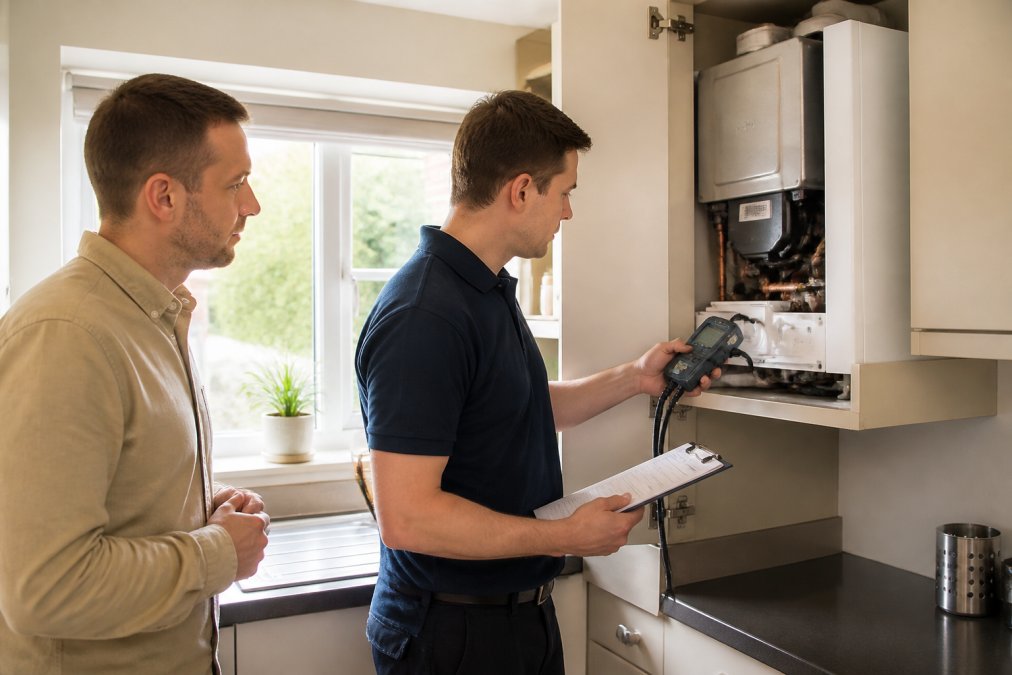
Use this checklist to stay compliant:
- Book the check before the 12-month deadline, not on it
- Confirm the engineer’s Gas Safe registration and check the ID card on arrival
- Ensure access to every gas appliance, including the boiler, hob, and any fire
- Ask the engineer to check flues and ventilation, not just the appliances
- Collect the gas safety record on the day
- Give existing tenants a copy within 28 days
- Give new tenants a copy before they move in
- File the record and diarise next year’s date
Diarise the check for 11 months after the last one, not 12. That gives you a buffer if the engineer needs to reschedule, and it keeps you inside the legal window.
What a Landlord Gas Safety Certificate Cost Covers
A landlord gas safety certificate cost reflects the engineer’s time and the scope of the inspection, not a fixed government fee. Pricing depends on the number of appliances, the property’s location, and how accessible the appliances are.
What the certificate covers:
- A visual inspection of each gas appliance
- Checks on flue performance and ventilation
- Testing for gas leaks and unsafe combustion
- A written record listing each appliance checked and any defects found
What it does not cover is repairs. If the engineer finds a fault, that is a separate job. This is where landlords get caught out: the check is a snapshot, not a service. A boiler can pass its safety check and still be overdue a service.
Because pricing varies by property and appliance count, ask for a free quote rather than working from a generic figure. Major Heat provides transparent pricing and free quotes so you know where you stand before booking.
How Long to Keep Gas Safety Records and Why It Matters
Gas safety records must be kept for at least two years from the date of the check. Two years covers the current check plus the previous one, which is what you need if a dispute or inspection arises.
The record itself must include the engineer’s details, the date of the check, the address, a list of appliances checked, and any defects identified and action taken.
Why it matters: if a tenant, a council officer, or the HSE asks for proof, a missing record is treated the same as a missing check. You cannot demonstrate compliance without the paperwork. Store records digitally as well as on paper, and keep them separate from the tenancy file so they survive a change of tenant.
When Tenants Report a Fault: Your Repair Duties
When a tenant reports a gas fault, you must act. The law requires you to maintain gas appliances and flues in a safe condition, and that duty does not pause because a repair is inconvenient.
Your obligations when a fault is reported:
- Respond promptly and arrange an inspection by a Gas Safe registered engineer
- If there is an immediate danger, such as a suspected gas leak, tell the tenant to call the National Gas Emergency Service on 0800 111 999 and leave the property
- Arrange the repair, and use a registered engineer for the work
- Keep a record of the fault, the action taken, and the outcome
A common mistake is treating a reported fault as the tenant’s problem to chase. It is not. The repair duty sits with you, and delay increases both the safety risk and your legal exposure.
Never ask a tenant to “keep an eye on” a faulty appliance while you arrange a visit. If it fails in the meantime, you are liable, and the consequences can be fatal.
Penalties for Getting It Wrong
Failing to meet landlord responsibilities for gas appliance maintenance carries serious penalties. The HSE can prosecute, and the courts can impose an unlimited fine. In the most serious cases, where a breach leads to death or serious injury, a custodial sentence is possible.
Beyond prosecution, there are practical consequences. A council can take enforcement action, your landlord insurance may be invalidated, and you may be unable to let the property until compliance is restored.
The penalties scale with the risk created. A missed check that causes no harm is still an offence. A missed check that leads to a carbon monoxide incident is a tragedy with legal consequences that follow you for years.
Frequently Asked Questions
What are a landlord’s legal responsibilities for gas safety?
Landlords must arrange an annual gas safety check on every gas appliance and flue in a rental property, carried out by a Gas Safe registered engineer. You must keep a record of the check for at least two years and give a copy of the certificate to existing tenants within 28 days of the check. For new tenants, provide the certificate before they move in. You are also responsible for maintaining appliances and flues in safe working order throughout the tenancy.
How long do I need to keep gas safety records?
You must keep a copy of the gas safety record for at least two years from the date of the check. This record includes details of each appliance checked, any defects found, and the actions taken. If you use a letting agent, they may hold copies, but the legal duty remains yours. Keeping records for longer than two years is sensible in case of disputes, insurance claims, or if you change letting agents.
What happens if a landlord fails to carry out gas safety checks?
Failing to comply with gas safety duties is a criminal offence. You could face an unlimited fine and up to six months in prison. If a tenant is harmed because of your negligence, you could also face prosecution under health and safety law. Your local authority or the Health and Safety Executive can take enforcement action. Not having a valid certificate also invalidates many landlord insurance policies, leaving you financially exposed.
Do landlords have to provide a copy of the gas safety certificate to tenants?
Yes. You must give existing tenants a copy of the gas safety record within 28 days of the annual check. For new tenants, you must provide it before they occupy the property. If you use a letting agent, they can handle this on your behalf, but you remain legally responsible. Tenants can also request a copy at any time, and you should provide it promptly. Keeping a digital copy makes this easier.
Gas appliance compliance is one of the few landlord duties where cutting corners can end in a courtroom. Major Heat’s Gas Safe registered engineers handle annual gas safety checks, servicing, and repairs across the region, with transparent pricing and free quotes so you can budget without guesswork. Get started with Major Heat and keep your rental property compliant, safe, and legally sound.