Table of Contents
- Combi Boiler vs System Boiler: The Quick Comparison
- How Many Bathrooms Can a Combi Boiler Support?
- Pros and Cons of System Boilers for Large Properties
- Water Pressure and Flow Rates: Where System Boilers Win
- Boiler Installation Cost: What Affects the Price in a Large Home
- Which Boiler Suits Your Large Home? A Decision Framework
- Frequently Asked Questions
Last Updated: September 19, 2026
Combi Boiler vs System Boiler: The Quick Comparison
Choosing between a combi boiler vs system boiler for large homes comes down to one question: how many hot water outlets will run at the same time? A combi boiler heats water on demand and needs no tank, while a system boiler stores hot water in a cylinder ready for several bathrooms at once. This guide from Major Heat breaks down where each type wins, what drives boiler installation cost, and which suits a large property.
The short answer: most large homes with two or more bathrooms are better served by a system boiler. Combi units suit smaller households with modest demand. Get this decision wrong and you will either run out of hot water at peak times or pay for capacity you never use.
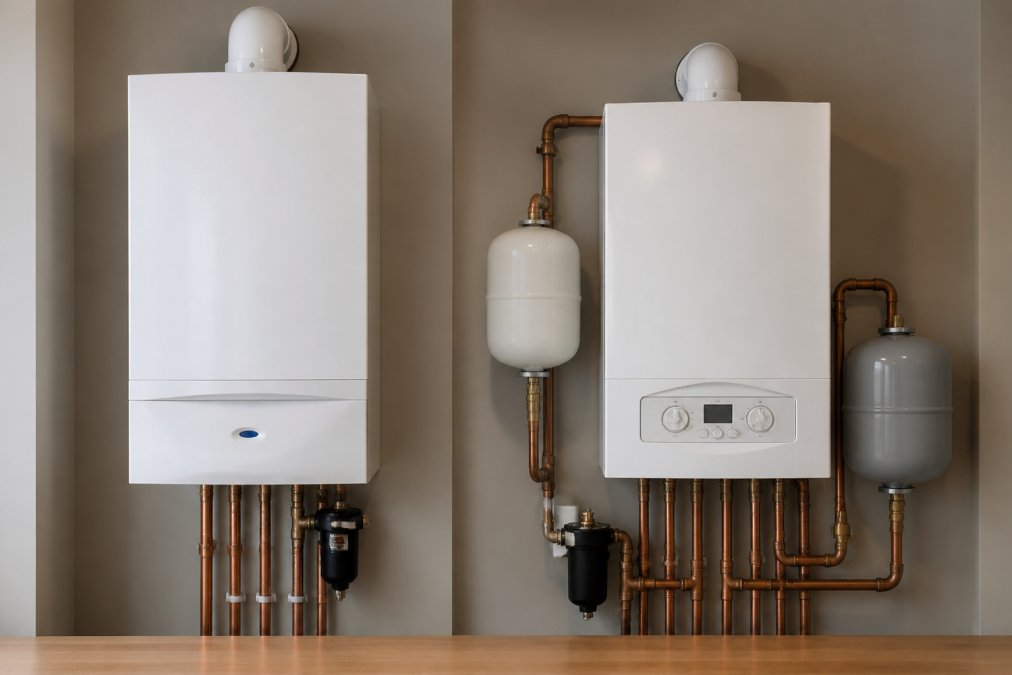
Here is the practical difference. A combi heats water the moment you turn on a tap, so there is no cylinder and no waiting. A system boiler works with a separate cylinder, so hot water is stored and ready. For a busy family home, that stored supply is often the deciding factor.
| Feature | Combi Boiler | System Boiler |
|---|---|---|
| Hot water source | Heated on demand | Stored in a cylinder |
| Best for | Small to medium homes | Large homes, multiple bathrooms |
| Simultaneous outlets | One or two | Several at once |
| Space needed | No tank or cylinder | Space for a cylinder |
| Water pressure | Depends on mains supply | Maintained by the cylinder |
| Suits high demand | Poorly | Well |
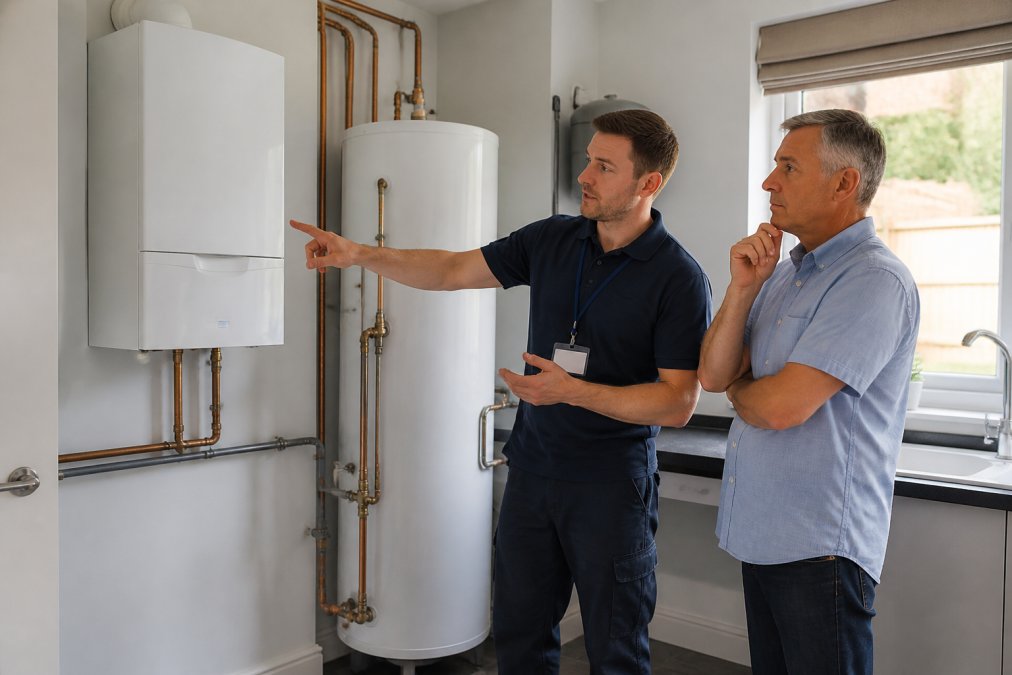
The combi boiler vs system boiler choice for a large home usually comes down to simultaneous hot water demand. If two or more bathrooms run at once, a system boiler is the safer bet.
How Many Bathrooms Can a Combi Boiler Support?
A combi boiler comfortably supports one bathroom at a time. It can usually manage a second outlet if the mains flow rate is strong, but running two showers together will often leave the second one lukewarm.
The limit is not the boiler’s power alone. A combi heats water as it passes through, so the flow rate of your mains supply caps how much hot water you get. Turn on a second shower and the first one slows. That is the trade-off.
For a large home with two or more bathrooms in regular use, this is where the combi boiler vs system boiler decision usually tips. A system boiler feeds from a stored cylinder, so several taps and showers can run together without the pressure dropping. If your household has staggered morning routines, a combi may cope. If everyone showers at once, it will not.
Pros and Cons of System Boilers for Large Properties
System boilers are built for high-demand homes. They store hot water in a cylinder and use a pump to keep pressure steady across multiple outlets, which is why they suit larger properties so well.
Pros:
- Handles several bathrooms running at the same time
- No cold-water tank in the loft, only a cylinder
- Works well with solar thermal or other stored-water systems
- Steady pressure across the whole house
Cons:
- Needs space for a hot water cylinder
- You pay to keep a cylinder of water hot, even when unused
- Hot water can run out if the cylinder is undersized for demand
The pros and cons of system boilers come down to space and demand. If you have a cupboard or airing space for a cylinder and a household that uses hot water heavily, the stored supply is a clear win. If not, a combi keeps things simple.
Sizing the cylinder too small is the most common mistake in a large home. A cylinder that cannot meet peak demand will run cold mid-shower, which defeats the point of choosing a system boiler in the first place.
Water Pressure and Flow Rates: Where System Boilers Win
System boilers win on water pressure and flow rate in large homes. A stored cylinder plus a pump delivers a steady supply to several outlets, so pressure holds up even when the whole household is using water at once.
A combi relies on your incoming mains pressure. In many properties that is fine for one shower, but it drops the moment a second outlet opens. For a large home with a busy family, that inconsistency is the main reason people move to a system boiler.
The practical test is simple. Count how often two or more hot-water outlets run together in your home. If it happens most mornings, a system boiler will handle it. If it is rare, a combi can cope and saves you the cylinder space.
Boiler Installation Cost: What Affects the Price in a Large Home
Boiler installation cost in a large home depends on more than the unit itself. The type you choose, the size of the cylinder, the flue route, and any changes to pipework all affect the final figure.
A system boiler installation usually costs more upfront because it involves fitting a cylinder and often a pump. A combi swap is simpler, which keeps labour down. But price is not the whole story. A system boiler that meets your hot water demand may cost less to run over time than a combi that struggles at peak load.
Because every home is different, the honest answer is that pricing depends on your property, your current system, and what needs changing. Major Heat provides free quotes, so you get a clear figure before any work begins rather than a vague estimate.
Ask for the quote to separate the boiler, the cylinder, and the labour. That breakdown makes it easy to compare quotes fairly and spot where one is cutting corners on the cylinder size.
Which Boiler Suits Your Large Home? A Decision Framework
Use this framework to settle the combi boiler vs system boiler question for your property. Work through the questions in order and the answer usually becomes obvious.
- Do two or more bathrooms run hot water at the same time most days? If yes, lean system.
- Do you have space for a hot water cylinder? If no, a combi is the practical choice.
- Is your mains water flow rate strong? If weak, a system boiler is safer.
- Is your household size four or more people? If yes, stored hot water helps.
- Do you plan to add a bathroom or en-suite? If so, plan for a system boiler now.
If you ticked mostly system answers, a stored-water setup will serve you better. If you ticked mostly combi answers, a combi keeps things simple and frees up space. When you are unsure, a Gas Safe registered engineer can measure your flow rate and demand on site and give you a straight recommendation.
The brands matter less than the sizing. A well-sized system boiler from a reputable maker will outperform an oversized or undersized unit every time. What most guides miss is that the cylinder and the flow rate decide your comfort far more than the badge on the boiler.
A large home puts real demands on its heating system, and the wrong choice shows up every morning when the second shower runs cold. Major Heat’s Gas Safe registered engineers fit, service, and repair both combi and system boilers, and we give free quotes so you know the cost before we start. With expert installations, reliable emergency support, and transparent pricing, we help you pick the setup that actually suits your property. Get started with Major Heat and get hot water that keeps up with your household.
Frequently Asked Questions
Can a combi boiler handle a large house with multiple bathrooms?
A combi boiler can struggle in a large house with more than one bathroom because it heats water on demand and cannot supply two showers at once without a drop in pressure. If your home has three or more bathrooms, a system boiler paired with a hot water cylinder is usually the better choice. For two bathrooms used at different times, a high-output combi might just cope, but check the flow rate first.
What are the main advantages of a system boiler over a combi?
A system boiler stores hot water in a cylinder, so it can supply several taps and showers at the same time without losing pressure. That makes it ideal for large homes with multiple bathrooms. It also works well with solar thermal or heat pump upgrades later. The trade-off is that you need space for a cylinder, and you pay to keep a tank of water hot.
How does a system boiler affect water pressure in a large home?
A system boiler maintains steady water pressure because it draws from a stored supply and uses a pump to push water through the cylinder. This means showers stay strong even when someone runs a tap downstairs. A combi boiler, by contrast, can see pressure drop when two outlets are used at once. In a large property, that difference is often the deciding factor.
Is it cheaper to run a combi or a system boiler in a big house?
Running costs depend on how you use hot water. A combi only heats water when you turn on a tap, so it avoids standing losses from a cylinder. But in a large home with high demand, a combi may run less efficiently at peak times. A well-insulated system boiler with a cylinder can be economical if you use timers and set the cylinder thermostat correctly. A Gas Safe engineer can advise on your specific usage.
What is the best boiler type for a home with three or more bathrooms?
For three or more bathrooms, a system boiler with a large unvented cylinder is typically the best choice. It can deliver hot water to multiple outlets simultaneously without pressure loss. A combi boiler would need to be very high output and may still fall short. If you have the space, a system boiler gives you the performance and reliability a large household needs.