
Table of Contents
- What the Cost of Switching From Gas to Heat Pump Actually Covers
- Air Source Heat Pump Installation Cost: What Drives the Figure
- Boiler Upgrade Scheme Grant: How It Reduces Your Outlay
- Heat Pump Running Costs Compared With Gas: The Ongoing Picture
- Radiator Upgrades for Heat Pumps: A Cost You Cannot Skip
- Step-by-Step: How the Switching Process Works
- Frequently Asked Questions
Last Updated: 13 October 2026
What the Cost of Switching From Gas to Heat Pump Actually Covers
The cost of switching from gas to heat pump is not one number. It is a bundle of separate costs, and knowing which is which stops you overpaying. The total usually splits into four parts: the heat pump unit and its installation, any radiator or pipework changes, the removal of your old gas boiler, and the ongoing running cost once the system is live.
Homeowners fixate on the headline installation figure and forget the extras. Then the final bill surprises them.
So what are you actually paying for?
- The heat pump unit itself, sized to your home
- Labour to design, fit and commission the system
- Radiator and pipework upgrades where the existing ones are too small
- Boiler removal and making good the old gas connection
- Running costs once the system is in use
The exact figure depends on your property, not a national average. That is why a free quote matters more than any online calculator.
Ofgem guidance on home energy sets out how running costs are worked out, which helps you compare quotes fairly.
The installation quote and the running cost are two different budgets. Judge a heat pump on both, or the cheaper install can cost you more over ten years.
Air Source Heat Pump Installation Cost: What Drives the Figure
Air source heat pump installation cost depends on four things: the size of the unit your home needs, how much of the existing heating system can stay, the complexity of the install, and where the unit sits. No two homes quote the same.
Here is what moves the number up or down.
- Heat loss and home size: A larger, poorly insulated home needs a bigger unit.
- Insulation levels: Better insulation means a smaller, cheaper unit.
- Existing radiators: Undersized radiators add to the bill.
- Pipework: Narrow pipes may need replacing.
- Unit location: A straightforward wall mount costs less than a complex route.
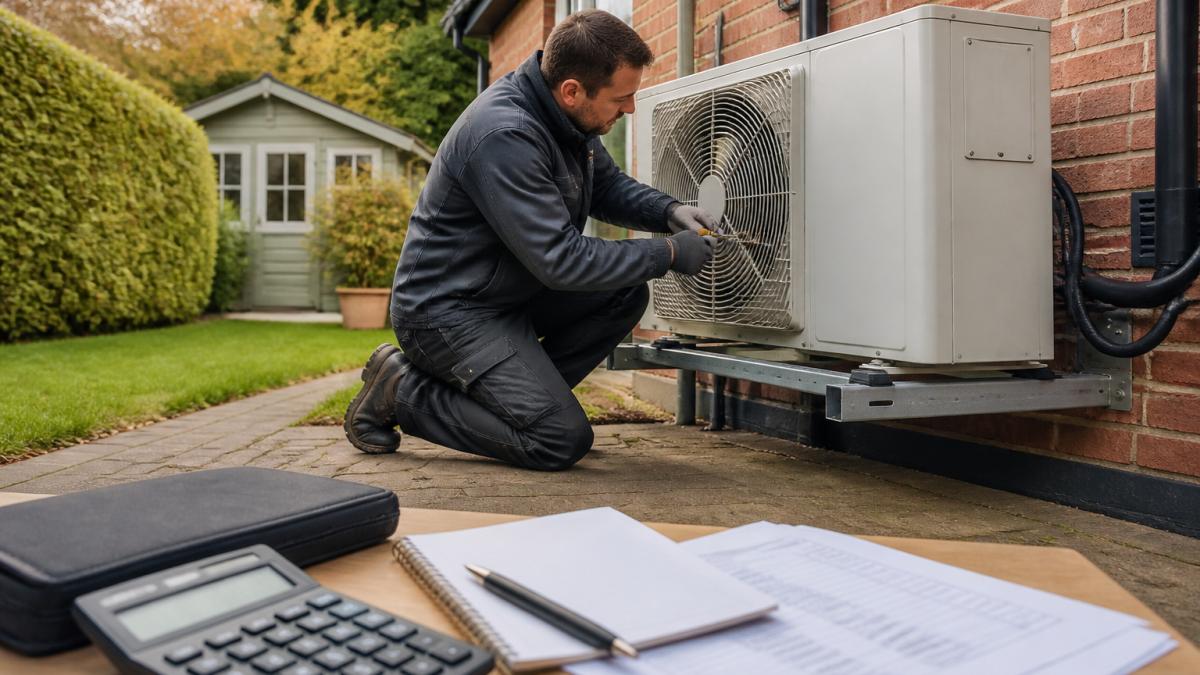
Property factors that change the quote
Older homes with solid walls and single glazing usually need more work. Newer, well-insulated homes often need less. The unit itself is only part of the job.
A common mistake is assuming a like-for-like swap. Heat pumps run at lower temperatures than gas boilers, so the whole system has to be matched to them. That is the single biggest reason quotes vary so much between neighbours.
Boiler Upgrade Scheme Grant: How It Reduces Your Outlay
The Boiler Upgrade Scheme grant is a government payment that cuts the upfront cost of a heat pump. It is administered by Ofgem, and it is claimed by your installer on your behalf, so you do not have to apply yourself.
The grant amount and eligibility rules change over time. We will not quote a figure here, because it must be current to be useful. Check the official scheme page for the latest amount before you budget.
- The installer applies, not you
- The property must meet the scheme rules
- You must have a valid EPC
- The work must be done by an approved installer
Boiler Upgrade Scheme official guidance confirms the current amount and eligibility. Always check it before signing anything.
Ask your installer to confirm the grant is included in the quote, not added later. A good quote shows the grant as a line item so you can see exactly what you pay.
Heat Pump Running Costs Compared With Gas: The Ongoing Picture
Heat pump running costs compared with gas come down to efficiency, not fuel price alone. A heat pump moves more heat per unit of electricity than a boiler produces per unit of gas. That higher efficiency is what can bring running costs down, especially in a well-insulated home.
The catch is electricity costs more per unit than gas. So the efficiency gain has to be big enough to outweigh that gap. In a leaky home with undersized radiators, it often is not.
- Well-insulated home: running costs can be lower than gas
- Poorly insulated home: costs can be higher
- Correct sizing: essential for low running costs
- Smart controls: help you run the system at its best
This is where the install and the running cost meet. A cheap install that skips radiator upgrades usually means higher bills later. Pay now or pay monthly, but you pay.
Radiator Upgrades for Heat Pumps: A Cost You Cannot Skip
Radiator upgrades for heat pumps are the cost homeowners most often try to avoid, and the one that causes the most problems. Heat pumps run at lower flow temperatures, so radiators must be larger to give out the same heat.
Skip this and the system runs cold. It also works harder, which pushes running costs up.
- Existing radiators are often too small
- Larger radiators give out more heat at lower temperatures
- Some rooms may need bigger units or extra ones
- Underfloor heating can replace radiators in some rooms
A proper heat loss survey tells you which radiators need changing. If an installer quotes without checking your radiators, treat that quote with caution.
Energy Saving Trust advice on heat pumps explains how radiator sizing affects performance.
Step-by-Step: How the Switching Process Works
Switching from gas to a heat pump follows a set process. Knowing the steps helps you plan your budget and your time.
- Book a heat loss survey. An engineer measures your home and sizes the unit.
- Get a full quote. It should cover the unit, labour, radiators and boiler removal.
- Confirm grant eligibility. Your installer checks the Boiler Upgrade Scheme rules.
- Upgrade radiators and pipework. This happens before or during the install.
- Fit the heat pump. The unit goes outside, connected to your heating system.
- Commission and test. The system is set up and checked for correct running.
- Remove the old boiler. The gas connection is made safe and the boiler taken away.
- Handover. You get a walkthrough of the controls and settings.
| Step | What Happens | Who Does It |
|---|---|---|
| Survey | Heat loss measured, unit sized | Installer |
| Quote | Full cost broken down | Installer |
| Grant | Eligibility checked and claimed | Installer |
| Radiators | Upgrades fitted where needed | Installer |
| Install | Heat pump fitted and wired | Installer |
| Commission | System tested and set up | Installer |
The whole job usually takes a few days, depending on radiator work. Getting the survey right at the start is what keeps the rest on track.
Frequently Asked Questions
How much does it cost to switch from a gas boiler to a heat pump?
The total cost of switching from gas to a heat pump depends on your property size, insulation levels, and whether radiators need upgrading. Costs include the heat pump unit, installation labour, any radiator replacements, and gas boiler removal. The Boiler Upgrade Scheme grant reduces the figure, but the final amount varies by home. Major Heat provides free quotes so you get an accurate figure for your property rather than a generic estimate.
Can I get a grant to replace my gas boiler with a heat pump?
Yes. The Boiler Upgrade Scheme grant is available to homeowners in England and Wales who are replacing a fossil fuel heating system with a heat pump. The grant is paid directly to the installer and deducted from your quote. You must have a valid EPC with no outstanding recommendations for loft or cavity wall insulation. An approved installer can confirm eligibility and handle the application.
Are heat pumps cheaper to run than gas boilers?
Heat pump running costs compared with gas depend on your electricity tariff, how well your home is insulated, and the flow temperature your system runs at. Heat pumps are more efficient per unit of heat delivered, but electricity costs more per kWh than gas. With a well-insulated property, correct radiator sizing, and a smart tariff, running costs can be competitive. Poor insulation or undersized radiators will push costs higher.
Do I need new radiators when switching from a gas boiler to a heat pump?
Not always, but radiator upgrades for heat pumps are common. Heat pumps run at lower flow temperatures than gas boilers, so radiators need to emit more heat at that lower temperature. Some existing radiators may be adequate; others will need replacing with larger or higher-output models. A room-by-room heat loss calculation determines exactly which radiators stay and which need upgrading. This is included in a proper survey.
Switching from gas to a heat pump is a bigger decision than a boiler swap, and the cost depends on your home, not a headline figure. Major Heat offers Gas Safe registered engineers, free quotes, and clear pricing so you know what you are paying for before work starts. We handle the survey, the grant paperwork and the install as one job. Get started with Major Heat and get a quote built around your home, not a guess.