Table of Contents
- Common Causes of Low Water Pressure in Maidstone
- How to Tell If It’s Your Supply or Your Plumbing
- How to Check Water Pressure at Home
- Low Water Pressure in One Tap
- Sudden Low Water Pressure: What Changed?
- Low Hot Water Pressure
- When to Call a Professional About Low Water Pressure in Maidstone
- Frequently Asked Questions
Last Updated: 12 October 2026
Common Causes of Low Water Pressure in Maidstone
Few things disrupt a morning quite like a weak trickle from the shower. If you’re searching for the common causes of low water pressure in Maidstone, you’re likely dealing with a problem that has a handful of usual suspects. At Major Heat, we see this call constantly across Kent.
Low water pressure is a reduction in the force of water flowing through your pipes and out of your taps. It usually points to a blockage, a leak, or a problem with your supply.
The good news? Most causes are fixable. Below, we’ll show you exactly how to trace the source, from a single tap to your whole house.
How to Tell If It’s Your Supply or Your Plumbing
The first step is working out whether the problem is inside your home or coming from the mains. This single check saves hours of guesswork.
Here’s the quick test:
- Ask a neighbour if they have the same issue
- If they do, it’s likely a supply problem
- If they don’t, the fault is in your plumbing
A supply issue sits with your water company, not you. A plumbing issue is yours to fix. Knowing which one you face tells you who to call.
How to Check Water Pressure at Home
You can check your water pressure with a simple gauge that screws onto an outside tap. This gives you a reading in bar, the standard unit for water pressure.
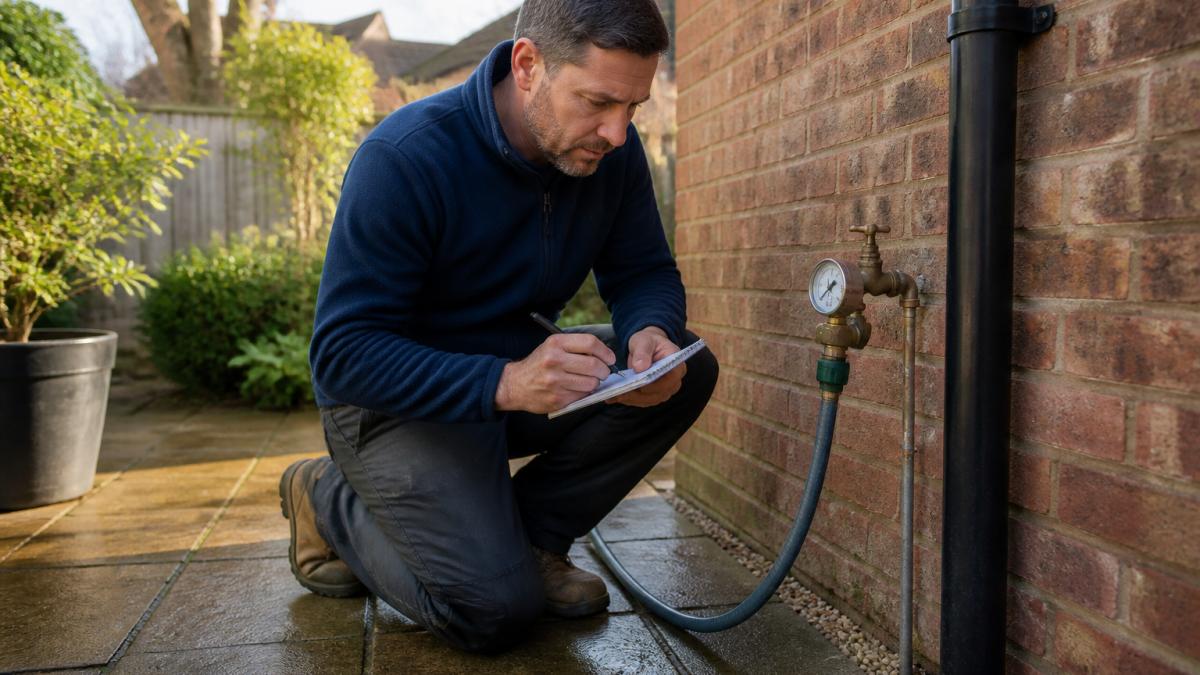
Using a Pressure Gauge on an Outside Tap
Attach the gauge, turn the tap on fully, and read the dial. A normal reading for most homes sits between 1 and 1.5 bar. Anything much below 1 bar suggests a weak supply.
- Turn off all other taps first
- Screw the gauge on tightly to avoid leaks
- Open the tap fully and wait a few seconds
- Note the steady reading, not the first spike
If your reading is low, the issue is coming into the house. If it’s normal, the problem is somewhere in your internal pipework.
Take your reading at the same time of day on two or three occasions. Pressure often drops during peak morning and evening hours when demand across the street is highest.
Low Water Pressure in One Tap
When low water pressure in one tap is the issue, the cause is almost always local to that fitting. The rest of your home works fine, which narrows things down fast.
Common culprits include:
- A clogged aerator or filter on the spout
- A worn washer or valve inside the tap
- A partially closed isolation valve under the sink
- Limescale build-up in hard water areas
Unscrew the aerator at the end of the spout and check for debris. Soak it in vinegar if it looks scaled. If that doesn’t fix it, the valve body may need replacing.
Sudden Low Water Pressure: What Changed?
Sudden low water pressure usually means something has just failed or changed. Unlike a gradual decline, a sudden drop points to a specific event.
Work through these possibilities:
- A burst or leaking pipe somewhere on your property
- A water company repair or main flush in your street
- A stuck or faulty stopcock
- Recent work that left a valve partly closed
Check for damp patches, running sounds in walls, or a water meter that keeps moving when all taps are off. Any of these signals a leak. A leak won’t fix itself, and it can damage your home the longer it runs.
If your water meter dial spins while every tap is closed, you have a leak. Ignoring it wastes water and can lead to damp, mould, and structural damage.
Low Hot Water Pressure
Low hot water pressure is often a boiler or cylinder issue rather than a mains problem. Cold water can flow fine while hot water struggles, and that split is your clue.
Typical causes include:
- A blocked or scaled heat exchanger
- A faulty diverter valve on a combi boiler
- Sediment build-up in the cylinder or pipes
- A kinked or blocked flexible tap connector
If only the hot side is weak, the mains supply is not the problem. The fault sits in your heating system. That’s a job for a Gas Safe registered engineer, not a general handyman.
At Major Heat, our engineers trace these faults with proper diagnostic tools.
When to Call a Professional About Low Water Pressure in Maidstone
Call a professional when the cause isn’t obvious or when the fix involves gas or sealed heating parts. Some jobs are safe to try yourself. Others are not.
Book an engineer if you notice:
- Low pressure on the hot side only
- A boiler showing a fault code
- Signs of a hidden leak
- No improvement after checking taps and valves
Work on gas appliances and sealed systems must be done by a Gas Safe registered engineer. It’s a legal requirement, and it keeps you safe. You can check any engineer’s registration through the official Gas Safe Register.
Major Heat is Gas Safe registered, and we cover Maidstone and the surrounding Kent towns. Our pricing is transparent, and quotes are free.
If the problem is hot water only, or you see a boiler fault code, stop and call a registered engineer. DIY fixes on gas systems are illegal and dangerous.
Frequently Asked Questions
What are the most common causes of low water pressure in a house?
The most common causes are a partially closed stopcock, a leaking pipe, limescale build-up, a faulty pressure-reducing valve, or a problem with your water supplier. In Maidstone, hard water areas often see limescale restricting flow, especially in older properties. If the issue affects every tap, the cause is likely at the mains or stopcock. If it’s one tap, the problem is usually local to that fixture or its supply pipe.
Why has my water pressure suddenly dropped?
A sudden drop usually points to a burst or leaking pipe, a neighbour using a lot of water, or a change in your supplier’s network. In some cases, a failed pressure-reducing valve or a blocked filter can cause a rapid loss. Check if your neighbours are affected; if so, contact your water company. If not, isolate your internal stopcock and call a plumber to inspect for leaks or valve issues.
How can I tell whether low water pressure affects one tap or the whole house?
Turn on each tap one at a time and note the flow. If only one tap is weak, the issue is likely a blocked aerator, a worn washer, or a faulty isolation valve on that branch. If every tap is weak, the problem is at the mains, the stopcock, or the supply pipe. Testing hot and cold separately also helps: if only hot is affected, the boiler or cylinder is the likely culprit.
Who should I contact about low water pressure in Maidstone?
First check with your water supplier to rule out a network issue. If your neighbours have normal pressure, contact a Gas Safe registered engineer or plumber. Major Heat serves Maidstone and the surrounding areas with emergency plumbing and heating support. Their engineers can diagnose stopcock issues, leaks, and boiler-related pressure problems. For transparent pricing and free quotes, visit Major Heat’s website or call their team.
Low water pressure rarely fixes itself, and the cause isn’t always where you’d expect. Whether it’s a single tap or your whole hot supply, getting it diagnosed properly saves time and money. Major Heat offers expert plumbing and heating support, reliable emergency assistance, and transparent pricing with free quotes. Get started with Major Heat and bring full pressure back to every tap in your home.