
Table of Contents
- Quick Comparison: Top Smart Thermostats for 2026
- What to Look For When Choosing the Best Smart Thermostat
- Smart Thermostat Compatibility with Combi Boilers
- Smart Thermostat Installation Cost UK: What to Budget For
- How to Reduce Heating Bills in 2026 with a Smart Thermostat
- Common Mistakes to Avoid When Buying a Smart Thermostat
- Frequently Asked Questions
Last Updated: September 13, 2026
Quick Comparison: Top Smart Thermostats for 2026
Choosing the best smart thermostat starts with matching the device to your boiler, your home’s layout and your budget. This guide from Major Heat breaks down compatibility, features and running costs so you can decide with confidence.
Here is how the leading models compare on the criteria that matter most:
| Model | Typical Price | Key Strength | Best For |
|---|---|---|---|
| Google Nest Learning Thermostat (3rd Gen) | £199.00 | Auto-Schedule learning | Hands-off automation |
| Ecobee Smart Thermostat Premium | £229.99 | Built-in air quality monitoring | Whole-home climate insight |
| Honeywell Home T9 | £160.00 | Smart Room Sensors | Homes with uneven heating |
| Nest Thermostat E | £130.00 | Discreet frosted display | Simple scheduling on a budget |
| Amazon Smart Thermostat | £60.00 | Alexa integration | Entry-level buyers |
The differences between these units come down to sensors, learning behaviour and how deeply they integrate with the rest of your smart home. Price alone tells you very little about which one will actually cut your bills.
What to Look For When Choosing the Best Smart Thermostat
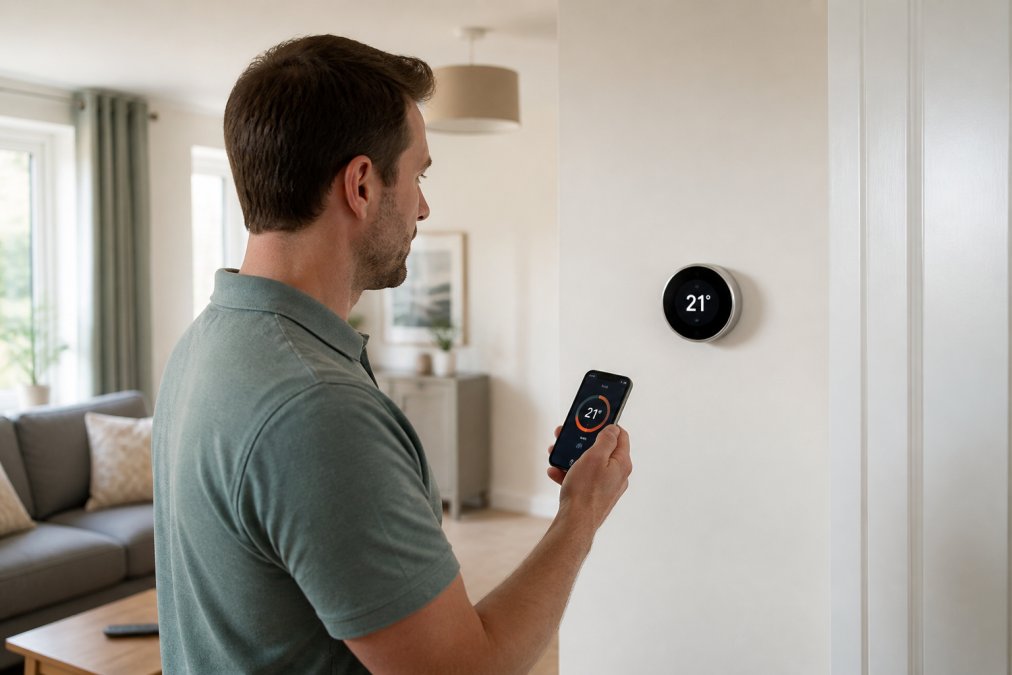
A smart thermostat is a heating control that learns your routine, responds to occupancy and lets you manage your boiler remotely through an app. The right model balances three things: compatibility with your existing system, the quality of its sensors, and how easily it fits your daily habits.
Heating System Compatibility
Compatibility is the first filter, and it eliminates more buyers than any other factor. Most smart thermostats are designed for low-voltage systems, so you need to confirm your boiler type, wiring setup and whether you have a separate hot water cylinder before buying.
A common mistake is ordering a thermostat before checking the wiring. If you are unsure, a Gas Safe registered engineer can confirm what your system supports in a single visit (gassaferegister.co.uk).
Scheduling, Sensors and Smart Features
Remote room sensors matter more than most buyers expect. A thermostat mounted in a hallway measures the temperature of your hallway, not your living room, which is why homes with uneven heat distribution benefit from sensor-based models.
Look for geofencing, which adjusts heating based on whether anyone is home, and clear energy reporting so you can see what your schedule is actually costing you.
Check the manufacturer’s compatibility checker using your exact boiler make and model, not just the fuel type. Two combi boilers from the same brand can have different control wiring.
Smart Thermostat Compatibility with Combi Boilers
Smart thermostat compatibility with combi boilers is generally straightforward, because a combi heats water on demand and needs no separate cylinder thermostat. Most modern combis work with the popular smart models, though older units may need a minor wiring adjustment.
The complication is OpenTherm and similar modulation protocols. Some boilers can accept a modulating signal that lets the thermostat control flow temperature directly, which is more efficient than simple on/off switching. Not every thermostat supports this, so it is worth confirming before you buy.
If your boiler is more than a decade old, the thermostat may not be the limiting factor. A heating engineer can tell you whether the boiler itself is worth upgrading alongside the controls.
Smart Thermostat Installation Cost UK: What to Budget For
Smart thermostat installation cost UK homeowners face depends on whether you go professional or DIY. The thermostat itself is the smaller part of the equation; labour and any wiring work are where budgets shift.
Pricing varies by property, existing wiring and engineer availability, so treat any quote as specific to your home. Major Heat provides free quotes so you can see the figure before committing.
Professional Installation vs DIY
DIY installation suits simple swaps where a compatible thermostat replaces an existing one with matching wiring. It takes an afternoon for a confident DIYer and saves on labour.
Professional installation is the safer route when wiring is unclear, when you want the boiler’s modulation features configured correctly, or when the work needs to be legally sound. A Gas Safe registered engineer can complete the job, confirm the system is safe and set up the schedule properly.
Attempting wiring work on a boiler without the correct registration is not just risky, it can invalidate your home insurance and breach gas safety rules (Gas Safety (Installation and Use) Regulations 1998 (GSIUR) as amended. Approved Code of…). If you are unsure, book an engineer.
How to Reduce Heating Bills in 2026 with a Smart Thermostat
How to reduce heating bills 2026 comes down to three behaviours: heating only the rooms you use, heating only when someone is home, and running your boiler at a lower flow temperature for longer.
Smart thermostats support all three. Zoning through remote sensors lets you prioritise occupied rooms. Geofencing stops you heating an empty house. Weather compensation and modulation, where supported, let the boiler run gently rather than in short bursts.
The savings come from consistency, not from the device alone. A thermostat that learns your routine will outperform a manual schedule every time, provided you let it run without constant overrides.
For guidance on efficient boiler operation, see Energy Saving Trust guidance on heating controls.
Common Mistakes to Avoid When Buying a Smart Thermostat
The biggest mistake is buying on price before checking compatibility. A cheap thermostat that cannot talk to your boiler is a wasted purchase, and return windows close quickly.
The second is ignoring the sensor setup. A single thermostat in a cold hallway will keep your whole house warmer than necessary, while a sensor-based system heats only what matters.
The third is skipping the professional check. Many homeowners discover wiring issues only after the unit arrives, which turns a simple swap into a booked engineer visit.
Match the thermostat to your boiler first, then to your habits. Price and brand come last, because a compatible mid-range model will always outperform a premium unit that fights your system.
Frequently Asked Questions
Are smart thermostats worth it for UK homes?
They can be, particularly if your current heating schedule wastes energy while you are out. A smart thermostat learns your routine and pauses heating when nobody is home, which reduces gas use over a full heating season. The savings depend on your boiler, insulation and how you currently run your heating. If your home already has good controls and you rarely change the schedule, the benefit is smaller. For households with irregular hours or older programmers, the improvement is usually more noticeable.
Do smart thermostats work with all boiler types?
No. Smart thermostat compatibility with combi boilers is generally straightforward because most modern combis support low-voltage or OpenTherm controls. Older conventional boilers with separate hot water cylinders may need additional wiring or a different model. System boilers and heat pumps can also work, but you should check the manufacturer’s compatibility list before buying. A Gas Safe registered engineer can confirm whether your boiler supports the thermostat you want, and whether any adaptor or extra wiring is needed.
What features should I look for in a smart thermostat?
Start with compatibility: check your boiler type and whether the thermostat supports your wiring. Then look at scheduling and occupancy detection, because these drive most of the savings. Remote room sensors help if some rooms are colder than others. Geofencing pauses heating when you leave. App quality matters more than marketing claims, so read reviews about reliability. Finally, check whether the model works with the smart home system you already use, such as Alexa, Google Home or Apple Home.
Can a smart thermostat help me save on my energy bills?
It can contribute to lower bills, but it is one part of a wider picture. The biggest gains come from not heating an empty house, which smart scheduling and geofencing handle well. Pair that with a boiler service, bleeding radiators and sensible thermostat temperatures to see the full effect. If your boiler is old or poorly maintained, a smart thermostat alone will not fix high usage. Ask a Gas Safe registered engineer to check your system first, then decide whether a thermostat upgrade is the right next step.
Heating controls only deliver savings when they are set up correctly for your specific boiler and home layout. Major Heat’s Gas Safe registered engineers handle boiler installations, servicing and repairs, and provide free quotes so you know the cost before any work begins. If you want your new thermostat configured properly the first time, get started with Major Heat and let our engineers confirm compatibility, complete the installation and set your schedule for efficient running from day one.