Table of Contents
- How to Tell If Your Gas Pipe Needs Upgrading for a New Boiler
- Gas Pipe Sizing for Combi Boilers: Why It Matters
- Signs of Undersized Gas Pipes You Should Not Ignore
- How to Check Your Current Gas Pipe Size
- The Process of Upgrading Gas Pipework: Step by Step
- Cost of Upgrading Gas Pipework: What Affects the Price
- Conclusion
- Frequently Asked Questions
Last Updated: September 23, 2026
How to Tell If Your Gas Pipe Needs Upgrading for a New Boiler
Most homeowners only think about gas pipework on the day the old boiler comes out. That is the worst time to find a problem. The question “Do I need to upgrade gas pipe for a new boiler?” comes down to one thing: whether your existing pipe can deliver enough gas to run the new appliance safely, or whether you must upgrade gas pipe first.
A straight swap often works fine. A bigger, more powerful boiler usually needs more.
Modern combi boilers pull far more gas than the old tank systems they replace. If the pipe feeding your boiler is too narrow, the new unit will underperform from day one. Worse, it may not run safely at all.
This guide explains how to check before you buy, so you are not caught out mid-installation.
Gas pipe sizing for combi boilers is not guesswork. It follows set rules based on pipe diameter, run length and the number of bends. Get it wrong and the boiler never reaches its rated output.
Here is how to tell which side of the line you fall on.
When a Straight Swap Is Fine
A straight swap is fine when the new boiler needs roughly the same gas input as the old one. This is common when you replace a like-for-like unit.
Signs you are probably safe:
- The new boiler has a similar kW rating to the old one
- Your existing pipework is already 22mm or larger
- The boiler sits close to the gas meter
- The old system ran without pressure problems
In these cases, a Gas Safe registered engineer can often reuse the existing pipe. They will still test it before signing off.
When the Existing Pipe Will Not Cope
The pipe will not cope when the new boiler needs more gas than the old one. This happens most often when switching from a regular or system boiler to a combi.
A combi heats water on demand. It needs a large, sudden burst of gas. An old 15mm pipe may not carry enough.
Watch for these warning signs:
- You are moving from a tank system to a combi
- The new boiler has a higher kW rating
- The boiler is far from the gas meter
- The pipe run has many bends or elbows
If any of these apply, ask for a pipe size check before you commit.
Gas Pipe Sizing for Combi Boilers: Why It Matters
Gas pipe sizing for combi boilers matters because an undersized pipe starves the boiler of gas. The boiler then cannot fire at full power. You pay for a powerful unit and get a weak one.
The right pipe size keeps gas pressure steady at the boiler. This lets the appliance run at its rated output and stay within safe limits.
Get it wrong and you get a boiler that:
- Takes forever to heat water
- Cycles on and off
- Throws up fault codes
- Fails its safety checks
This is not a small detail. It is the difference between a boiler that works and one that never quite does.
How Pipe Diameter, Length and Bends Affect Gas Flow
Three things decide how much gas a pipe can carry: diameter, length and bends.
- Diameter: A wider pipe carries more gas. Going from 15mm to 22mm roughly doubles capacity.
- Length: The longer the run, the more pressure you lose. A 20-metre run loses far more than a 5-metre one.
- Bends: Every elbow adds resistance. A pipe with six bends behaves like a much longer straight pipe.
So a short, straight 15mm run might be fine. The same pipe with a long run and several bends will not be. Engineers use sizing tables that account for all three at once.
Signs of Undersized Gas Pipes You Should Not Ignore
The clearest signs of undersized gas pipes show up when demand is highest. That usually means cold mornings, when the heating and hot water both kick in.
Look out for:
- The boiler struggles to reach temperature
- Hot water runs lukewarm, not hot
- Other gas appliances lose pressure when the boiler fires
- The boiler locks out and needs resetting
- A yellow, lazy flame instead of a crisp blue one
A yellow flame is a red flag. It can point to incomplete combustion, which is a safety concern. If you see one, stop using the appliance and call a Gas Safe registered engineer.
Never ignore a yellow or orange boiler flame. It can signal carbon monoxide production. Turn the appliance off and get it checked straight away.
How to Check Your Current Gas Pipe Size
You can check your current gas pipe size yourself in a few minutes. You do not need tools for the first step.
Here is how:
- Find the gas pipe running from your meter to the boiler
- Measure the outside diameter with a tape measure
- Compare it to standard sizes: 15mm, 22mm or 28mm
A 15mm pipe is about the width of a pencil. A 22mm pipe is closer to a 10p coin. If you are unsure, take a photo and show your engineer.
The pipe size alone does not tell the full story.
Check the pipe at the meter end, not just near the boiler. The narrowest point in the run is what limits gas flow. A pipe that starts at 22mm and drops to 15mm halfway still restricts supply.
The Process of Upgrading Gas Pipework: Step by Step
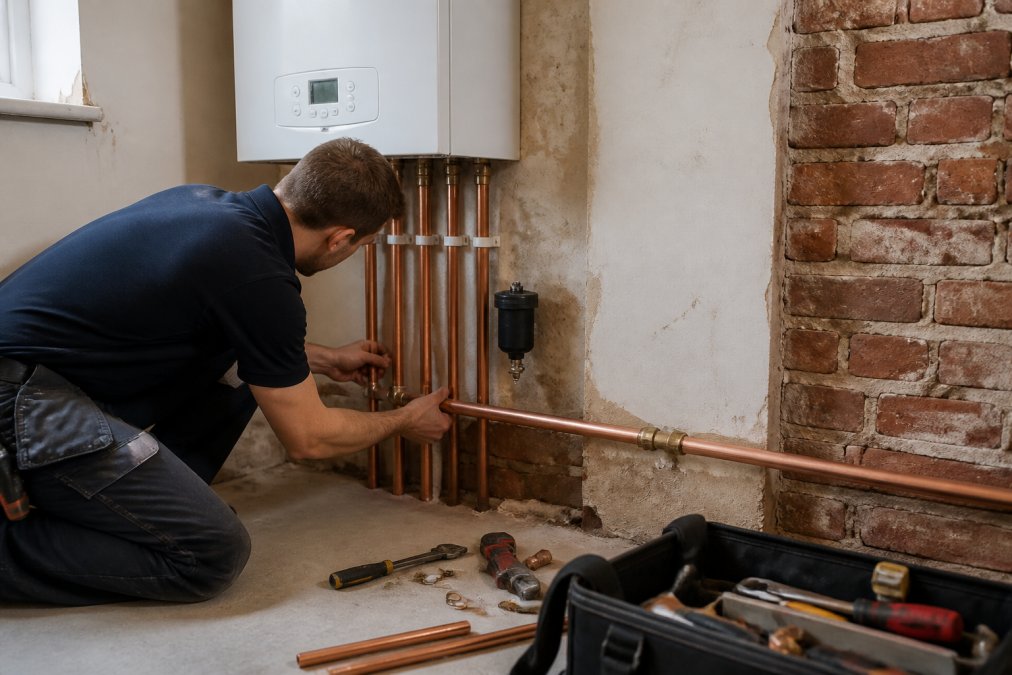
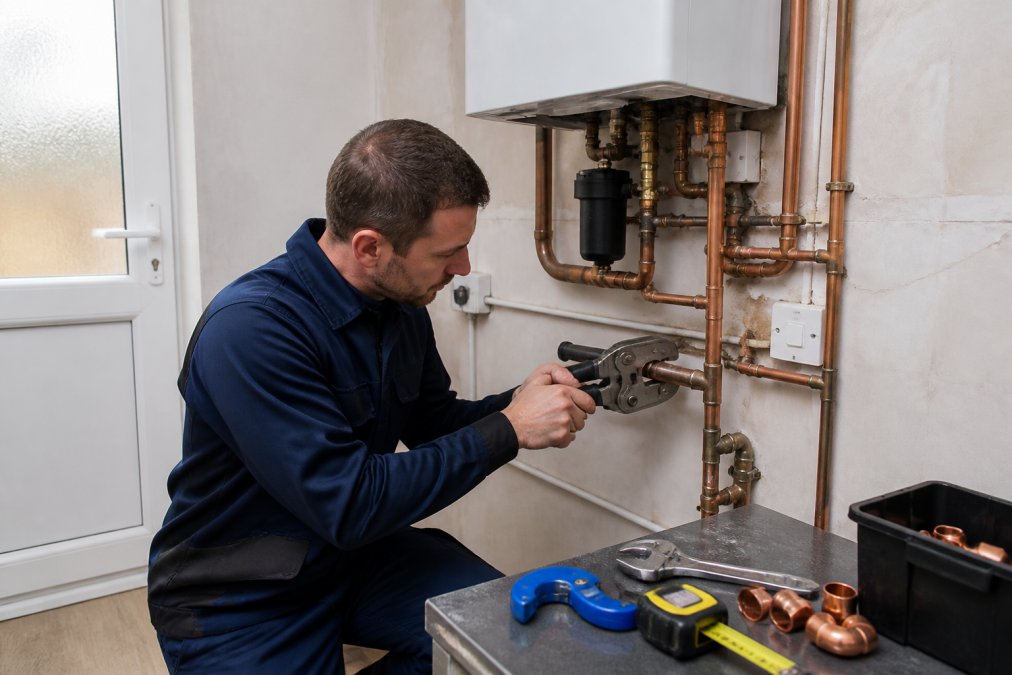
Upgrading gas pipework is a job for a Gas Safe registered engineer. Gas work is regulated, and doing it yourself is both illegal and dangerous.
Here is how the process usually runs:
- Survey: The engineer checks the boiler’s gas input and maps the pipe run
- Sizing: They calculate the correct pipe diameter for the length and bends
- Isolation: The gas supply is turned off and the system made safe
- Removal: Old pipe sections are taken out where needed
- Installation: New pipe is fitted, clipped and sealed
- Testing: The engineer checks for leaks and confirms pressure at the boiler
- Commissioning: The boiler is fired up and set to run correctly
What You’ll Need: Tools, Materials and Access
The engineer brings the tools. You just need to clear the way.
What the job involves:
- Copper pipe in 22mm or 28mm
- Compression or soldered fittings
- Pipe clips and supports
- A gas leak detector and pressure gauge
- Access to the meter, boiler and the full pipe route
Common Mistakes to Avoid During the Upgrade
The biggest mistake is sizing the pipe by eye. A pipe that “looks fine” can still be too narrow once you add up the length and bends.
Other mistakes to avoid:
- Reusing old fittings that may leak
- Ignoring other gas appliances on the same run
- Skipping the pressure test at the boiler
- Choosing a boiler before checking the pipe
Cost of Upgrading Gas Pipework: What Affects the Price
The cost of upgrading gas pipework depends on several factors, not a single flat rate. Two homes on the same street can get very different quotes.
What drives the price:
- Run length: Longer runs use more pipe and more labour
- Access: Pipes behind walls or under floors cost more to reach
- Diameter: Upgrading to 28mm costs more than 22mm
- Obstacles: Solid walls, tight lofts and boxing-in all add time
- Extra work: Moving the meter or adding isolation valves
The pipe, not the boiler, sets your true limit. Check the pipe first and you avoid paying for power your home cannot deliver.
| Factor | What It Does | Why It Matters |
|---|---|---|
| Run length | More pipe, more labour | Longer runs cost more |
| Access | Hard-to-reach pipes | Adds time and cost |
| Diameter | 22mm vs 28mm | Bigger pipe costs more |
| Obstacles | Walls, lofts, boxing | Slows the job |
| Extra work | Meter moves, valves | Adds to the total |
Conclusion
The real question is not whether you need a new boiler. It is whether your pipe can feed it. A straight swap often needs no change. A step up to a combi usually does.
Frequently Asked Questions
How do I know if my gas pipe is too small for a new boiler?
Look for signs of undersized gas pipes such as the boiler flame flickering or yellowing, other gas appliances losing pressure when the boiler fires, or the boiler frequently locking out. A Gas Safe registered engineer will measure the pipe diameter, run length and number of bends, then calculate whether the existing pipe can deliver the required gas flow for your new boiler. If it cannot, an upgrade to a larger diameter pipe is needed.
Does a combi boiler require a larger gas pipe than a standard boiler?
Often yes. Combi boilers typically need a higher gas input rate than conventional or system boilers of similar heat output, especially when providing instant hot water. This means the existing gas pipe may be too small to supply enough gas. The correct gas pipe sizing for combi boilers depends on the boiler’s specific input rating, the pipe run length and the number of bends. A Gas Safe engineer will confirm whether your current pipe is adequate.
What happens if my gas pipe is undersized for my new boiler?
An undersized gas pipe can starve the boiler of gas, leading to poor combustion, reduced performance and potential safety hazards such as carbon monoxide production. The boiler may frequently lock out or fail to ignite reliably. It can also affect other gas appliances in the home. A Gas Safe registered engineer must check pipe sizing during installation and will not commission a boiler if the gas supply is inadequate.
How much does it cost to upgrade gas pipework for a boiler?
The cost of upgrading gas pipework varies depending on the length of the run, the diameter required, whether the pipe is concealed in walls or floors, and the complexity of the route. Simple upgrades may be relatively straightforward, while longer runs or those requiring access to floors and walls will cost more. For an accurate figure, request a free quote from a Gas Safe registered engineer who can assess your property.