
Last Updated: October 24, 2026
Quick Summary
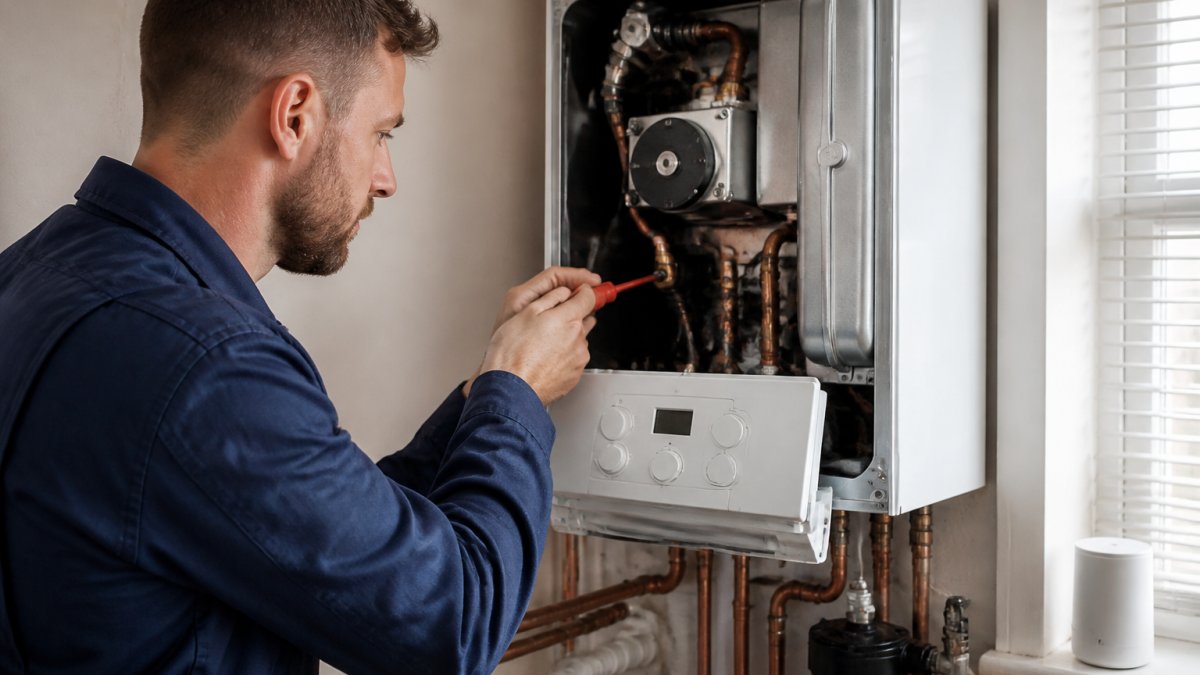
To maintain a high-efficiency boiler, check the pressure gauge monthly and top up only if it drops below the manufacturer’s recommended range, and book an annual service by a Gas Safe registered engineer. Regular boiler maintenance also means bleeding radiators, keeping vents clear and running the heating for 15 minutes each month in summer.
- A boiler should be serviced once a year by a Gas Safe registered engineer.
- Most systems sit between 1 and 1.5 bar when cold, so top up only if the gauge drops below range.
- Landlords need a Gas Safety Check every 12 months and must give tenants a copy of the certificate.
- Run the heating for 15 minutes each month in summer to keep seals supple and stop the pump seizing.
- Leave gas, flue and sealed casing work to a Gas Safe engineer; only simple tasks are safe to do yourself.
Table of Contents
- Why High-Efficiency Boiler Maintenance Pays for Itself
- How Often to Service a Boiler and What the Law Requires
- The Annual Boiler Service Checklist
- Boiler Pressure Checks: The Monthly Habit
- Signs a Boiler Needs Servicing Before It Breaks Down
- What You Can Safely Do Yourself Between Services
- Book Your Gas Safe Boiler Service with Major Heat
- Frequently Asked Questions
Why High-Efficiency Boiler Maintenance Pays for Itself
A high-efficiency boiler only stays efficient with regular boiler maintenance. Modern condensing boilers can recover heat that older models waste up the flue, but that advantage depends on clean components and correct settings. Skip the upkeep and you quietly lose the savings you paid for.
Boilers that get an annual service run more reliably and break down less often. Boilers that get ignored fail at the worst possible moment, usually during a cold snap when every engineer is booked solid.
So how do you maintain a high efficiency boiler properly? The answer is a mix of small monthly habits and one professional service a year. None of it is complicated. Most of it takes minutes.
Here is what most guides get wrong: they treat maintenance as a single annual event. In practice, the monthly checks matter just as much as the service itself. A pressure check takes two minutes and can flag a problem weeks before it becomes a breakdown.
Below, we break down the nine tasks that keep a high-efficiency boiler running safely and cheaply, and show you which ones you can do yourself.
How Often to Service a Boiler and What the Law Requires
A boiler should be serviced once a year by a Gas Safe registered engineer. That is the baseline for every gas appliance in a home, and it is also what most manufacturer warranties require to stay valid.
The legal picture depends on who lives there:
- Homeowners: An annual service is not a legal requirement, but it protects your warranty and your safety.
- Landlords: A Gas Safety Check is legally required every 12 months for all gas appliances, and you must give tenants a copy of the certificate.
- Anyone selling or renting: Buyers and tenants increasingly ask for service records, so keep them.
The check and the service are not the same thing. A Gas Safety Check confirms the appliance is safe to use. A full service cleans components, tests performance and catches wear before it causes a fault.
Before you book anyone, confirm their registration. You can check an engineer’s Gas Safe registration yourself on the official register, and it takes about a minute. Any engineer who hesitates to give you their licence number is one to avoid.
The Annual Boiler Service Checklist
A proper service follows a set routine. Here is what a Gas Safe engineer should work through during a boiler service:
- Visual inspection of the boiler, pipework and flue
- Flue gas analysis to confirm combustion is correct
- Check gas pressure and flow rate
- Clean the heat exchanger and burner
- Inspect and clean the condensate trap
- Test safety devices and controls
- Check the expansion vessel charge
- Confirm the boiler pressure is correct
- Record readings and issue a service report
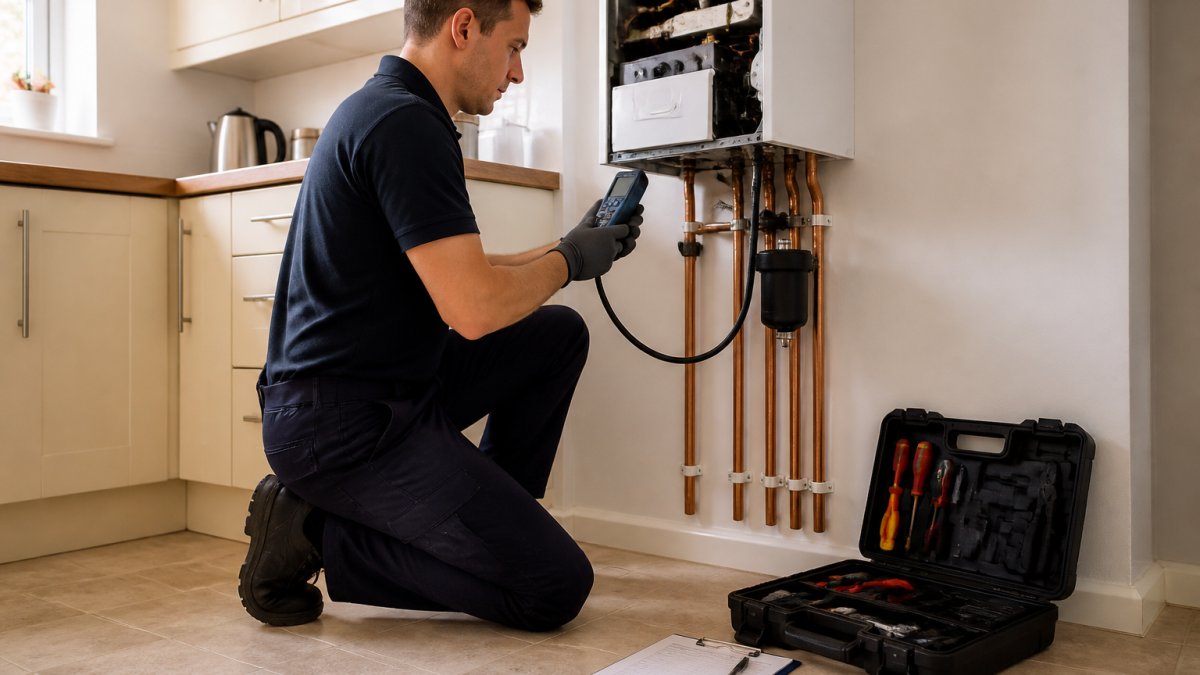
If your engineer skips the flue gas analysis or the condensate trap, ask why. Those two steps are where efficiency losses usually hide. A clean condensate trap also prevents the acidic water from backing up and corroding parts.
A proper annual service should cover these checks, carried out by a Gas Safe registered engineer.
| Task | What it involves |
|---|---|
| Visual inspection | Boiler, pipework and flue |
| Flue gas analysis | Confirms combustion is correct |
| Gas pressure and flow | Checked against required readings |
| Heat exchanger and burner | Cleaned during the service |
| Condensate trap | Inspected and cleaned |
| Safety devices and controls | Tested |
| Expansion vessel charge | Checked |
| Boiler pressure | Confirmed correct, then readings recorded |
Boiler Pressure Checks: The Monthly Habit
Boiler pressure checks are the simplest maintenance task you can do, and one of the most useful. Check the gauge once a month and top up only if it drops below the manufacturer’s recommended range. Most systems sit between 1 and 1.5 bar when cold.
Here is the routine:
- Find the pressure gauge, usually on the front of the boiler.
- Read the needle when the heating is off and the system is cold.
- If it is low, use the filling loop to add water slowly.
- Stop at the recommended level and close the valve fully.
- If pressure keeps dropping, book an engineer.
A slowly falling gauge often points to a small leak or a failed expansion vessel. Neither fixes itself.
Watch out: overfilling is a real risk. Too much pressure strains seals and can trigger the pressure relief valve, which then needs replacing. Add water in short bursts and recheck.
Signs a Boiler Needs Servicing Before It Breaks Down
Warning signs usually appear before a full breakdown. Catch them early and you book a routine visit instead of an emergency callout. The most common signs a boiler needs servicing are:
- Strange noises such as banging, kettling or whistling
- Yellow or orange flame instead of a crisp blue one (Gas safety – Carbon monoxide awareness frequently asked questions)
- Radiators that heat unevenly or stay cold at the bottom
- Rising gas bills with no change in usage
- Water stains or drips around the boiler casing
- The boiler locking out and needing a reset
If you spot a leak, check the signs of a leaking boiler before you do anything else. Some drips are minor, but water near electrics is never something to ignore.
Error codes are another early warning. Our guide on troubleshooting common boiler error codes explains what the most frequent codes mean and when to call an engineer.
What You Can Safely Do Yourself Between Services
You can handle the simple tasks. Anything involving gas, the flue or the sealed casing belongs to a Gas Safe engineer. That line is not negotiable, and it is there to keep you alive.
Safe jobs for homeowners:
- Check and top up pressure monthly
- Bleed radiators when they run cold at the top
- Keep vents and air bricks clear
- Run the heating for 15 minutes each month in summer
- Clean the boiler casing with a dry cloth
- Check the condensate pipe is not frozen in winter
Running the heating in summer keeps seals supple and stops the pump from seizing. It is a small habit that prevents a common autumn failure.
Power flushing is a different matter. It can restore efficiency in a sludged system, but whether it pays off depends on your radiators and pipework. Read up on whether power flushing saves money before you commit.
Book Your Gas Safe Boiler Service with Major Heat
Maintaining a high-efficiency boiler comes down to small habits and one proper annual service. Do the monthly checks, watch for warning signs, and leave the gas work to a registered engineer.
At Major Heat, our Gas Safe registered engineers handle servicing, repairs and installations across Gillingham, Maidstone, Sittingbourne, Ashford and Canterbury. We offer transparent pricing with free quotes, so you know the cost before we start. Our team also covers emergency callouts when a boiler fails without warning.
Don’t wait for a breakdown in January to find an engineer. Book a boiler service with Major Heat and keep your heating reliable, safe and efficient all year.
Frequently Asked Questions
How often should a high-efficiency boiler be serviced?
Once a year, ideally in late summer or early autumn before the heating season starts. Annual servicing keeps the warranty valid and catches wear before it becomes a breakdown. If you rent out the property, you also need a Gas Safety Record every 12 months from a Gas Safe registered engineer. Landlords sometimes book the service and the safety check in the same visit to save time.
What maintenance can I safely do on my boiler myself?
You can check the pressure gauge monthly and top up via the filling loop if it drops below about 1 bar when cold, bleed radiators, keep vents and flues clear of obstruction, and run the heating for ten minutes each month in summer. Anything involving the casing, the gas supply, the flue or the burner must be left to a Gas Safe registered engineer. Removing a boiler casing without competence is dangerous and can invalidate your warranty.
What does a boiler service include?
A typical service covers a visual inspection of the boiler and flue, a flue gas analysis to confirm combustion is correct, checks on pressure, seals and safety devices, cleaning of components where needed, and a written report. Use a boiler service checklist to confirm what your engineer covers. Ask for the Gas Safe registration number and check it on the Gas Safe Register before booking.
How do I know if my boiler needs maintenance?
Watch for signs a boiler needs servicing: banging or kettling noises, radiators that stay cold at the bottom, a yellow rather than blue flame, pressure that keeps dropping, higher gas bills without a change in usage, or the boiler locking out. Any of these warrants a call to a Gas Safe registered engineer rather than waiting for the annual visit. A carbon monoxide alarm on each floor is a sensible backstop.
A well-maintained boiler is one less thing to worry about when the temperature drops. Major Heat provides Gas Safe registered servicing, expert repairs and free quotes, backed by engineers who turn up when they say they will. Get started with Major Heat and keep your home warm without the guesswork.
