
Last Updated: November 24, 2026
Quick Summary
You should replace a leaking boiler when the leak comes from the heat exchanger or main body, when the same fault returns after two or three repairs, or when the boiler is over 12 years old and the repair bill climbs past a sensible share of a new unit’s cost. A single loose joint on a five-year-old boiler is a repair, while a corroded heat exchanger on a fifteen-year-old boiler is a replacement.
- Turn the boiler off at the controls and close the water supply valve on the filling loop.
- Internal leaks are the single strongest signal for replacement because the failed part is usually the boiler’s core.
- Treat 12 years as the point where you start asking the repair or replace question seriously.
- Ask the engineer whether the part is still manufactured and how long it will take to arrive.
- Compare the quoted repair figure with the cost of a new installation, not with zero.
Table of Contents
- When to Replace a Leaking Boiler
- Boiler Leaking Water? What to Do First
- Common Causes of a Boiler Leak
- Signs a Boiler Needs Replacing
- Boiler Leak: Repair or Replace?
- Boiler Repair Costs and Replacement Planning
- Book a Gas Safe Registered Engineer
- Frequently Asked Questions
When to Replace a Leaking Boiler
You should replace a leaking boiler when the leak comes from the heat exchanger or main body, when the same fault returns after two or three repairs, or when your boiler is over 12 years old and the repair bill climbs past a sensible share of a new unit’s cost. A single loose joint on a five-year-old boiler is a repair. A corroded heat exchanger on a fifteen-year-old boiler is a replacement.
The honest answer depends on three things: where the water is coming from, how old the unit is, and how often it has failed before. Below, we walk through what to do first, how to find the leak source, and a clear framework for deciding whether to repair or replace.
Boiler Leaking Water? What to Do First
Turn the boiler off at the controls and close the water supply valve on the filling loop. Then check whether the water is pooling near electrics. Water and electricity in the same cupboard is the one situation that needs an engineer immediately, not a DIY look.
If you have just noticed water, our guide to the signs of a leaking boiler explains what each type of leak usually means before you touch anything.
Switching Off the Boiler and Isolating the Supply
Do these in order:
- Switch off the boiler at the control panel, then at the fused spur if there is one.
- Close the water supply using the isolation valve on the cold feed or filling loop.
- Turn off the electricity to the boiler circuit at the consumer unit if water is anywhere near wiring.
- Place towels and a bucket under the drip to protect flooring and plasterboard.
- Do not tighten joints yourself on a gas appliance. That is a job for a Gas Safe registered engineer.
If water is running freely or has reached electrics, call for emergency plumbing help rather than waiting for a routine appointment.
What to Do While You Wait for an Engineer
Keep the area clear and stop using the boiler. Take photos of the leak and note where the water appears, because the leak source is often not where the puddle forms. Water runs along pipework and drips somewhere else entirely.
Watch out: mopping up and switching the boiler back on to “see if it settles” is the most common mistake we see. Pressurising a leaking system pushes more water through the failed part and can turn a small repair into a flooded ceiling.
Common Causes of a Boiler Leak
Most boiler leaks trace back to a handful of parts, and the part tells you how serious the job is. A loose compression fitting on copper pipework is minor. A failed heat exchanger or corroded main body is not.
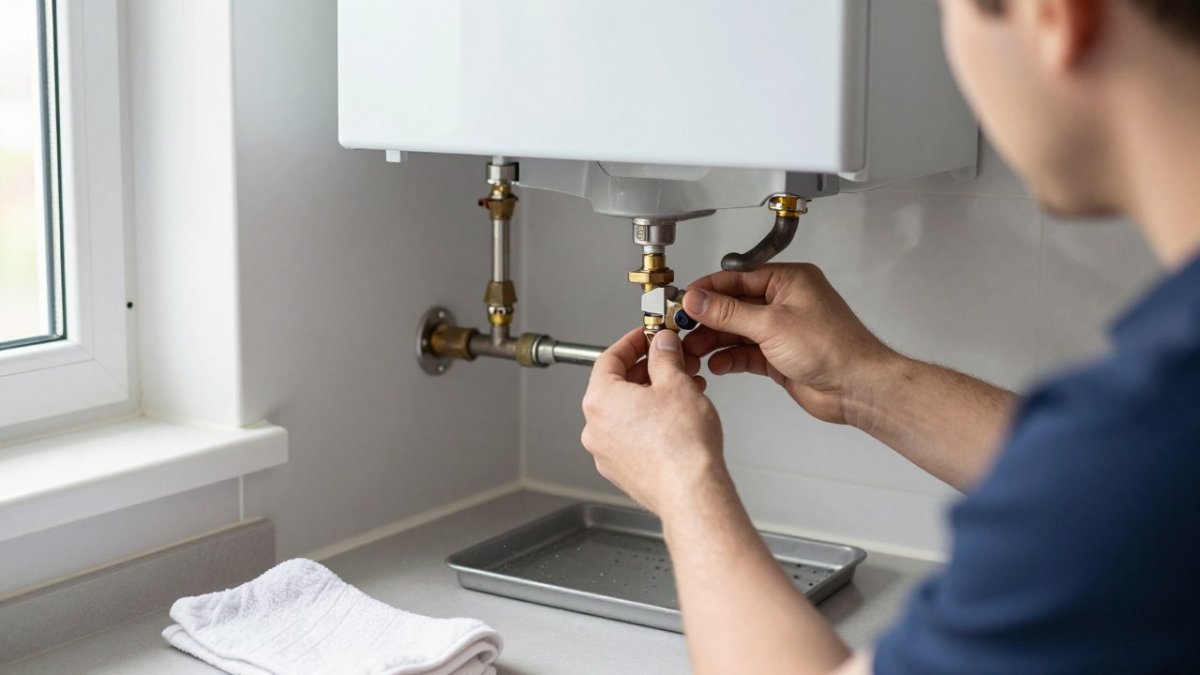
The usual culprits:
- Loose fittings and joints on pipework, often after vibration or a pressure change.
- Perished seals and washers inside valves and connections.
- A failing pressure relief valve that drips when pressure runs high.
- A corroded heat exchanger, which usually means the end of the boiler’s life.
- A blocked condensate pipe that backs up and overflows.
- A failed expansion vessel, which causes pressure swings and repeat leaks.
- Internal corrosion and rust in older units, which weakens the main body.
Where the water appears matters. A drip at a valve is a plumbing fix. Rust staining around the casing points to corrosion inside, and that changes the decision entirely.
Signs a Boiler Needs Replacing
Replace the boiler when the leak is internal, the unit is old, and repairs are stacking up. Age alone is not the trigger. A well-maintained boiler at ten years can still have years left. The combination of age, internal damage and repeat faults is what tips it.
Look for these signs:
- The boiler is over 12 years old and has needed several repairs.
- Water is coming from inside the casing, not from a joint.
- The same leak returns within weeks of a repair.
- Pressure keeps dropping even after topping up.
- You see rust or corrosion on the heat exchanger or main body.
- Parts are hard to source because the model is discontinued.
- Energy bills are climbing while heat output falls.
Our companion guide on the seven signs a gas boiler needs replacing goes deeper on each one, including the warning signs that are easy to miss.
Boiler Leak: Repair or Replace?
Repair the leak if it comes from an accessible joint, valve, seal or condensate pipe and the boiler is otherwise sound. Replace the boiler if the leak is internal, the unit is over 12 years old, or the repair cost approaches a large share of a new installation.
Work through them in this order. The first factor that fails decides the outcome; you do not need to score all five.
1. Leak location. External leaks, a drip at a visible joint, valve, seal or condensate pipe, are plumbing fixes. Internal leaks, where water appears inside the casing or stains the main body, point to the heat exchanger or a corroded shell.
2. Boiler age. Age alone is not a trigger. A well-maintained boiler at ten years can still have years left. But once a unit passes roughly 12 years, parts become harder to source, efficiency has typically fallen, and the economics of any repair shift against you. Treat 12 years as the point where you start asking the question seriously, not the point where you automatically replace.
3. Repair history. One leak on an otherwise reliable boiler is a repair. The same leak returning within weeks means the first repair missed the cause, and a second or third visit for the same fault is money spent without solving the problem.
4. Parts availability. Before committing to a repair, ask the engineer whether the part is still manufactured and how long it will take to arrive. Discontinued models can leave you waiting weeks for a component, or paying a premium for a pattern part. If the part is hard to source now, it will not get easier.
5. Repair cost against replacement. Compare the quoted repair figure with the cost of a new installation, not with zero. A repair that costs a large share of a new boiler, and leaves you with an ageing unit, is usually the wrong call. The next section sets out how to make that comparison in pounds.
Use this framework to sort your situation:
| Situation | Likely Cause | Recommended Action | Urgency |
|---|---|---|---|
| Drip at a visible joint or valve | Loose fitting, worn seal | Repair | Book within days |
| Water from pressure relief valve | High pressure, failed valve | Repair and check pressure | Prompt |
| Blocked condensate pipe | Frozen or clogged pipe | Clear and repair | Prompt |
| Repeat leak after repair | Underlying fault not fixed | Diagnose properly, consider replacement | High |
| Water inside the casing | Heat exchanger or body | Replace | High |
| Rust and corrosion on main body | Internal corrosion | Replace | High |
| Boiler over 12 years with repeat faults | Age and wear | Replace | Plan soon |
Two factors sharpen the call. First, leak location: internal leaks are far more serious than external ones. Second, recurrence: a leak that comes back means the first repair missed the cause. If your boiler is around 12 years old, our guide on whether a 12 year old boiler is worth repairing covers that specific decision in detail.
Watch out: deciding on cost alone, without checking parts availability and repair history, is how people end up paying twice, once for a repair that was never going to last, and again for the replacement they deferred.
Boiler Repair Costs and Replacement Planning
Repair costs vary widely by part and access, so Major Heat quotes after inspecting the boiler rather than guessing over the phone. The figure depends on the fault, the boiler type, access and your location. For current pricing or a free quote, visit the Major Heat website.
When you compare repair against replacement, compare like with like. A repair keeps your existing boiler and its remaining life; a replacement resets the clock, brings a warranty and usually improves efficiency. A repair that costs a large share of a new installation, and leaves you with an ageing unit, is rarely the better deal. Ask the engineer for the repair figure and the replacement figure side by side, and ask what warranty each carries.
For a replacement, plan around these steps:
- Get a proper assessment of the boiler and the property’s heating needs, not just the leak.
- Compare repair against replacement using the framework above, not emotion.
- Check parts availability for your model before committing to a repair.
- Budget for the full job, including any flue or pipework changes that a like-for-like swap may not cover.
- Ask about the warranty on both the boiler and the installation, and what it excludes.
- Book installation with a Gas Safe registered engineer and keep the paperwork, including the Benchmark certificate and any building regulations notification.
Major Heat offers free quotes. You can verify any engineer’s registration on the official Gas Safe Register before work begins. It takes two minutes and it is the single best protection you have.
Watch out: accepting a phone estimate for a heat exchanger or internal leak without an on-site inspection, the access and parts cost can move the figure substantially, and a quote given blind is the one most likely to change once the casing is open.
Book a Gas Safe Registered Engineer
A leaking boiler is a safety matter, not just a plumbing one. Gas appliances, pressure systems and electrics all sit in the same cupboard, and only a registered engineer should open that casing. Major Heat’s engineers are Gas Safe registered, and the business handles boiler installation, servicing and repairs.
If you are weighing up a repair against a new boiler, our boiler installation service covers what a replacement involves from assessment to commissioning.
Stop guessing whether your leaking boiler is worth saving. Major Heat provides expert boiler repairs, servicing and installations with Gas Safe registered engineers, transparent pricing and free quotes, so you get a straight answer and a safe, reliable heating system. Get started with Major Heat and book your assessment today.
Frequently Asked Questions
Should I replace my boiler if it is leaking?
Not always. A single leak from a loose joint or a failed seal is usually a straightforward repair. Replacement makes more sense when the leaking boiler is over 12 years old, has had repeat leaks or pressure loss, or the repair cost is a high share of a new installation. An engineer should confirm the fault before you decide.
Is a leaking boiler dangerous?
A water leak is rarely dangerous in itself, but it can damage electrics and pipework if left. A suspected gas leak is a different matter: if you smell gas, turn off the supply at the meter, open windows, avoid switches and flames, and call the National Gas Emergency Service on 0800 111 999 immediately.
How do I know if my boiler is beyond repair?
Warning signs include an age over 12 years, repeated leaks from the same joint, corrosion or rust on the heat exchanger, falling pressure that will not hold, and parts that are hard to source. If a Gas Safe registered engineer finds internal corrosion, replacement is usually the safer and cheaper route over time.
Can I still use my boiler if it is leaking?
Switch it off and isolate the water supply until an engineer has inspected it. Running a leaking boiler can worsen water damage, strain components and, where the leak reaches electrics, create a shock risk. Boiler cover or a warranty may also require you to stop using it and report the fault promptly.
