
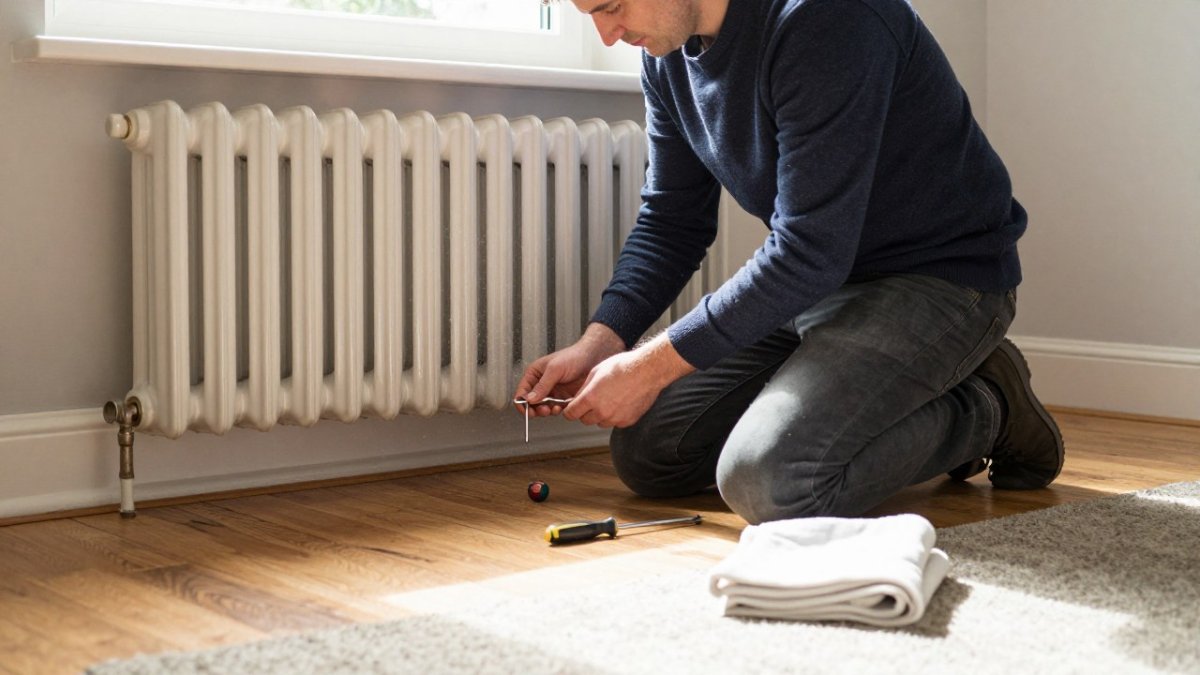
Last Updated: 7 November 2026
Quick Summary
To bleed radiators, switch off the heating and let them cool, then turn the bleed valve at the top corner anti-clockwise no more than a quarter turn with a radiator key. Hold a cloth underneath and close the valve clockwise once water runs in a steady stream. Repeat on each radiator, then check the boiler pressure.
- A radiator that is cold at the top but warm at the bottom almost certainly has trapped air.
- Use a proper radiator key rather than pliers, which can round the soft brass valve edges.
- Bleed one radiator at a time, starting at the lowest and working upwards as a safe default.
- Boiler pressure often drops slightly after bleeding, so top up via the filling loop if needed.
- Bleeding once a year before the heating season starts is a sensible habit.
Table of Contents
- Signs a Radiator Needs Bleeding
- What You Need: Radiator Bleeding Key and Basic Tools
- How to Bleed Radiators Step by Step
- Which Radiators to Bleed First in a Multi-Storey Home
- Checking Boiler Pressure After Bleeding Radiators
- Radiator Still Cold After Bleeding? What to Check Next
- Safety Guidance for Different Heating Systems
- How Much Bleeding Radiators Actually Improves Efficiency
- Frequently Asked Questions
Signs a Radiator Needs Bleeding
If your radiator is cold at the top but warm at the bottom, trapped air is almost certainly the cause.
Trapped air rises to the top of the radiator and stops hot water filling the panel. The result is uneven heating: warm at the base, stone cold along the top edge.
Watch for these signs a radiator needs bleeding:
- Cold at the top, hot at the bottom
- Gurgling, bubbling or hissing sounds when the heating starts
- Radiators that take far longer to warm up than they used to
- Patchy heat across the panel
- A heating system that needs frequent top-ups on pressure
One more clue: if only upstairs radiators are affected, air has likely collected at the highest point of the system.
What You Need: Radiator Bleeding Key and Basic Tools
You need a radiator bleeding key, a cloth and a small container. That is the whole kit. A flat-head screwdriver works on some older valves, but a proper radiator key is cheap and grips the valve square without chewing the edges.
Gather these before you start:
- Radiator bleeding key (sometimes sold as a bleed key)
- Old towel or cloth
- Small jug or shallow container
- Torch for dim corners
A common mistake is using pliers on the valve. The brass is soft, and rounded edges make the next bleed much harder. Buy the key.
How to Bleed Radiators Step by Step
Here is the full process, start to finish. Work through it in order and you will not go far wrong.
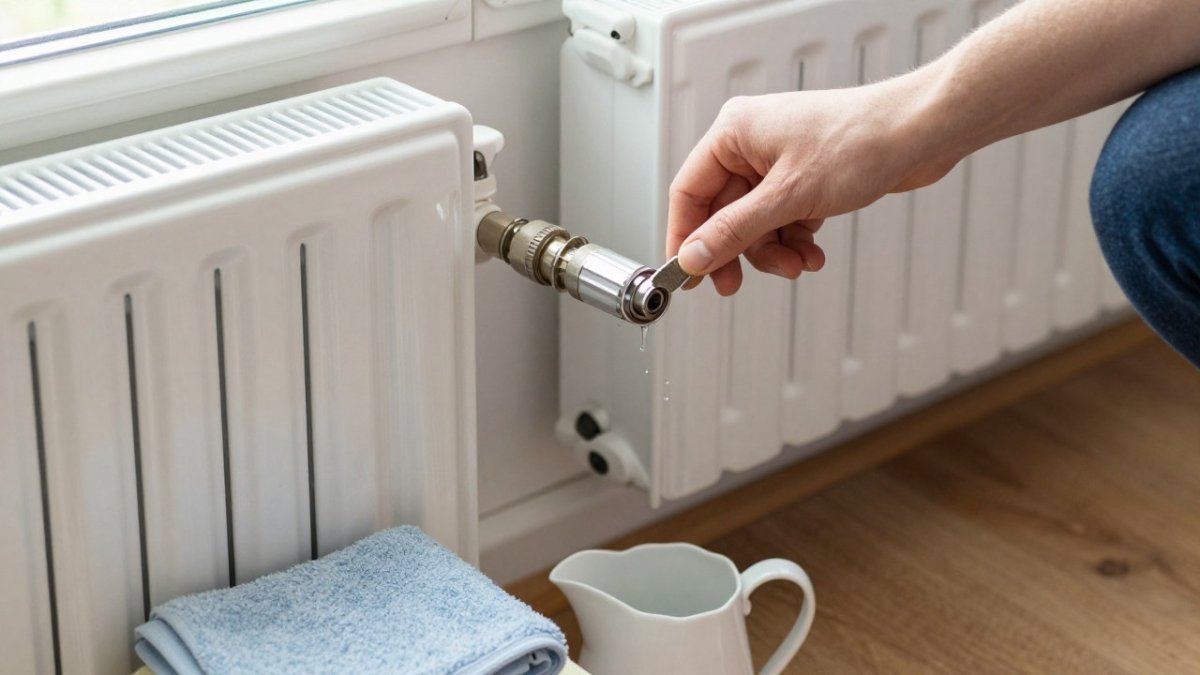
Switch Off the Heating and Let Radiators Cool
Turn the heating off at the controls and wait until the radiators are cool to the touch. Hot water under pressure can scald, and cool radiators are safer to work on.
Locate the Bleed Valve and Open It a Quarter Turn
The bleed valve sits at the top corner of the radiator, usually at one end. Fit the radiator key onto the square spindle and turn it anti-clockwise, no more than a quarter turn. You should hear a hiss as trapped air escapes.
Hold the cloth under the valve and keep the jug ready. Water will follow the air.
Close the Valve When Water Runs Steady
As soon as water flows in a steady stream with no spitting or hissing, close the valve by turning it clockwise. Do not overtighten it. A firm nip is enough. Wipe any drips and check for leaks after a few minutes.
Repeat on each radiator, then switch the heating back on and check the heat is even across every panel.
Here is the process at a glance, from switching off the heating to checking the heat is even.
| Step | What to do | Note |
|---|---|---|
| Switch off heating | Turn heating off and wait until radiators are cool | Hot water under pressure can scald |
| Locate bleed valve | Valve sits at top corner of the radiator | Usually at one end |
| Open the valve | Turn key anti-clockwise no more than a quarter turn | Listen for a hiss of escaping air |
| Catch the water | Hold cloth under valve and keep jug ready | Water will follow the air |
| Close the valve | Turn clockwise when water runs steady | Do not overtighten; a firm nip is enough |
| Check for leaks | Wipe drips and check again after a few minutes | Repeat on each radiator |
| Restore heating | Switch heating back on and check even heat | Check every panel |
Which Radiators to Bleed First in a Multi-Storey Home
The common advice is to start at the lowest radiator and work upwards, finishing at the highest point in the system.
But the ‘lowest first’ rule is not universal, and the right order depends on how your system is laid out. A few practical points to weigh up:
- Where the pump sits. On many sealed systems the pump is near the boiler, and the boiler may be on the ground floor or in a first-floor airing cupboard. If the pump is upstairs, bleeding the highest radiators first can sometimes clear air more effectively because you are working with the pump’s flow rather than against it. If you are unsure, the lowest-first approach is the safer default.
- Sealed versus open-vented. On an open-vented system with a feed-and-expansion tank in the loft, air can be drawn in through the vent pipe if the system is running while you bleed. Always bleed with the heating off and the system cool, and check the small tank has water in it before you start. On a sealed system, the pressure gauge is your reference point instead.
- One radiator at a time. Bleed a single radiator, close the valve, then move to the next. Bleeding several at once on a sealed system can drop pressure faster than the filling loop can keep up, and on an open-vented system it can pull air into the pipework.
- Radiators on separate zones. If your home has upstairs and downstairs on separate heating zones (common with newer controls), bleed each zone’s radiators in turn, starting with the lowest in that zone.
Watch out: if you bleed the top floor first on a system where the pump is downstairs, you can pull air down into lower radiators and end up repeating the job.
A quick way to confirm you have the order right is to feel each radiator after the heating has run for 15-20 minutes.
Checking Boiler Pressure After Bleeding Radiators
Boiler pressure often drops slightly after bleeding radiators, because you have released water along with the air. Check the pressure gauge on the boiler once the system has cooled. Sealed systems typically show their correct operating pressure on the gauge marking, as set out in the boiler manufacturer’s instructions.
If the pressure has fallen below that zone, top up using the filling loop, following the boiler manufacturer’s instructions. Do not overfill. You can book a boiler service to have the pressure and the whole system checked properly.
Radiator Still Cold After Bleeding? What to Check Next
A radiator that stays cold after bleeding usually has a circulation problem, not an air problem. Work through these checks before assuming the worst:
- Check the valves. Make sure both the lockshield and the control valve are open.
- Check the boiler pressure. Low pressure can stop heat reaching upstairs radiators.
- Check for sludge. Cold spots at the bottom of a radiator often mean black sludge has settled inside.
- Check the pump. If several radiators are cold, the pump may be failing.
If bleeding has not fixed it, sludge or a balance issue is the likely culprit. A power flush may be worth investigating if the system has not been cleaned in years. For anything beyond a basic check, our team handles central heating repairs and maintenance and can diagnose the cause properly.
Safety Guidance for Different Heating Systems
Sealed systems, open vent systems and combi setups all bleed the same way, but the pressure checks differ. On a sealed system, watch the gauge and top up if needed. On an open vent system, check the small tank in the loft has water in it before you start.
A few safety precautions apply to every system:
- Never bleed a radiator while the heating is running
- Keep the key straight so you do not damage the valve
- Stop if water keeps running and will not close off
- Call a Gas Safe registered engineer if you smell gas or the boiler locks out
If you want a deeper walkthrough on safe technique, our guide on how to bleed radiators safely at home covers the finer points. Gas work itself is not a DIY job.
How Much Bleeding Radiators Actually Improves Efficiency
Bleeding radiators can improve efficiency by restoring even heat across the panel, which may help the system reach the thermostat temperature more readily. Any gain depends on how much air was trapped in the first place.
Rather than expecting a specific bill saving, it is more useful to measure the change yourself. A few checks you can do before and after bleeding:
- Warm-up time. Time how long it takes for the radiator to feel hot across the whole panel after the heating comes on. A bled radiator should heat evenly from top to bottom.
- Temperature uniformity. Run a hand across the panel from top to bottom and left to right. Cold patches at the top before bleeding that disappear afterwards are the clearest sign the job worked.
- Boiler cycling. Listen for how often the boiler fires and stops. If it was short-cycling because one radiator was air-locked and the system could not reach temperature, bleeding can reduce that cycling, but only if the air was the cause.
- System pressure stability. On a sealed system, note the gauge reading before and after. A small drop is normal; a continuing fall points to a leak rather than an efficiency gain.
What bleeding will not do is fix a system that is sludged, badly balanced, or running at the wrong pressure.
For a bigger impact, pair bleeding with other habits: bleeding once a year before the heating season starts, keeping the boiler serviced annually by a Gas Safe registered engineer, and balancing radiators so heat is spread evenly. Our guide on ways to lower heating bills covers the wider picture, and if you want the system checked properly you can book a boiler service.
Bleeding your radiators is a job most homeowners can do in an afternoon, but it will not fix a system with deeper problems.
Frequently Asked Questions
Should the heating be on or off when bleeding a radiator?
Turn the central heating off and let the radiators cool before you start. Bleeding a hot radiator risks scalding from water and steam, and the system needs to be settled for the pressure reading to mean anything. Once you have closed every valve, check the boiler pressure gauge and top up if it has dropped below the manufacturer’s recommended cold setting, then run the heating to confirm the cold spots have gone.
Can bleeding radiators reduce heating bills?
It can help, but keep expectations realistic. Trapped air stops the top of a radiator heating up, so the boiler runs longer to reach the same room temperature. Releasing that air restores full heat distribution across the panel and can shorten warm-up times. The saving is modest on its own, and it is largest where several radiators are badly airlocked.
Do you need to check boiler pressure after bleeding radiators?
Yes, always. Bleeding releases water as well as air, so the system pressure drops slightly each time. Check the pressure gauge on the boiler once the heating is off and the system is cool. If it sits below the manufacturer’s cold-fill figure, usually marked on the gauge or in the manual, repressurise using the filling loop and recheck. Never leave a boiler running at low pressure, and call a Gas Safe registered engineer if it keeps falling.
What should you do if a radiator is still cold after bleeding?
If the top is now warm but the bottom stays cold, the likely cause is sludge or a stuck valve rather than air. Check that both valves are open, then look at whether other radiators in the house are affected. A single cold radiator often points to a closed valve or a seized thermostatic head. If several are cold, or the boiler pressure will not hold, stop and book a Gas Safe registered engineer to investigate before the problem spreads.
