
Last Updated: November 13, 2026
Quick Summary
You stop a condensate pipe freezing by insulating the whole external run with waterproof lagging, sealing every joint and keeping the heating on a low setting overnight in cold weather. For long or repeatedly frozen runs, add trace heating or reroute the pipe internally.
- External condensate pipes should be 32 mm in diameter, with a fall of about 3 degrees.
- Use waterproof, closed-cell lagging on outdoor runs and seal every joint with insulation tape.
- Thaw a frozen pipe with warm, not hot, water, working from the boiler end outward.
- Never use boiling water, a blowtorch or a naked flame on a condensate pipe.
- Never open the boiler casing to reach a condensate connection; that is Gas Safe work.
Table of Contents
- Why Condensate Pipes Freeze and How to Spot It Early
- Frozen Condensate Pipe Symptoms: What Your Boiler Is Telling You
- Condensate Pipe Size and Installation: Getting the Specs Right
- How to Insulate a Boiler Condensate Pipe Properly
- How to Thaw a Frozen Condensate Pipe Safely
- Prevention by Pipe Route and Property Layout
- When Prevention Fails: Safe Escalation to a Gas Safe Engineer
- Book a Gas Safe Check Before the Cold Sets In
- Frequently Asked Questions
Why Condensate Pipes Freeze and How to Spot It Early
A condensing boiler pulls heat from its own exhaust, and that process creates water. That water leaves the boiler through the condensate pipe, and in sustained cold it can freeze solid. When it does, the boiler locks out and your heating stops. This is one of the most common winter callouts, and most cases are preventable.
The trap is that condensation forms all winter, not just in a cold snap. One blocked pipe is enough to shut the whole system down.
Frozen condensate pipe symptoms to check first
Look for these before you ring anyone:
- The boiler has locked out, with a fault code or reset light showing
- There is gurgling or bubbling from the boiler or the pipe
- Water is dripping or pooling near the boiler
- The external pipe is white with frost or visibly iced at the end
If you spot a fault code, check what it means before you act. Our guide on how to troubleshoot common boiler error codes explains the common ones.
Frozen Condensate Pipe Symptoms: What Your Boiler Is Telling You
A frozen condensate pipe usually announces itself with a lockout, not a bang. The boiler senses it cannot drain and shuts down to protect itself. That is a safety feature working as designed.
Most modern boilers show a specific fault code for a blocked condensate route. Some show a general lockout instead. Either way, the pattern matters: the boiler runs, then stops, then runs again after a reset, then stops once more.
That cycle is the giveaway. A boiler that keeps locking out in cold weather is telling you the drain is blocked, not that the boiler is broken.
Condensate Pipe Size and Installation: Getting the Specs Right
The single biggest cause of repeat freezing is a pipe that was too small or badly routed from day one. Get the installation right and most of this problem disappears.
Here is what a correct install looks like, and why each part matters:
- Diameter: 32 mm for anything run externally. A smaller pipe holds less water and has a greater surface-area-to-volume ratio, so the contents freeze faster. Upsizing to 32 mm gives the condensate more thermal mass and a wider bore that resists ice bridging at bends.
- Fall: a continuous fall of about 3 degrees (roughly 50 mm per metre) so water never sits still. Standing water is what freezes first and blocks the route. A fall that is too shallow lets water pool; a fall that is too steep can cause the condensate to run faster than the pipe can drain at the outlet, which is why the gradient is specified rather than left to chance.
- Length: keep external runs as short as possible. Every metre of exposed pipe is another metre that has to be insulated, traced or rerouted.
- Route: discharge internally to a drain or soil stack wherever you can. An internal route removes the freeze risk almost entirely, which is why it is the preferred permanent fix rather than a last resort.
British Standard BS 6798 and the boiler maker’s own instructions set these requirements, and the two should be read together, the standard gives the minimum, while the manufacturer’s instructions often add stricter requirements for a particular model. The BSI guidance on condensing boiler installation is worth checking if you are querying an existing install.
A common pattern is a boiler installed with a short external run in 22 mm pipe and a fall that looks adequate to the eye but is closer to 1 degree over the run. That install passes a casual inspection and freezes in the first hard frost.
If the pipe route or sizing is wrong, a proper fix means boiler installation by Gas Safe registered engineers, not a patch-up. Rerouting a condensate pipe internally may involve lifting flooring or running new pipework through a wall, and upsizing an external run means replacing the pipe rather than lagging it.
How to Insulate a Boiler Condensate Pipe Properly
Insulation is the cheapest fix you can make, and most people do it badly.
Do it properly:
- Measure the pipe diameter and buy lagging that fits snugly. Loose lagging leaves an air gap that lets cold air circulate along the pipe.
- Use waterproof, weatherproof lagging on any outdoor run. Standard internal foam lagging absorbs water and loses its insulating value once damp, so look for closed-cell material rated for external use.
- Seal every joint with insulation tape, leaving no gaps. Joints are where cold penetrates first, and a gap of a few millimetres is enough to start a freeze.
- Clip the lagging so it cannot slip down the pipe. Gravity pulls lagging off vertical runs over time, exposing the top section.
- Check the whole external run, not just the visible part. The section behind a downpipe or at a bend is the one most often missed and the one most likely to freeze.
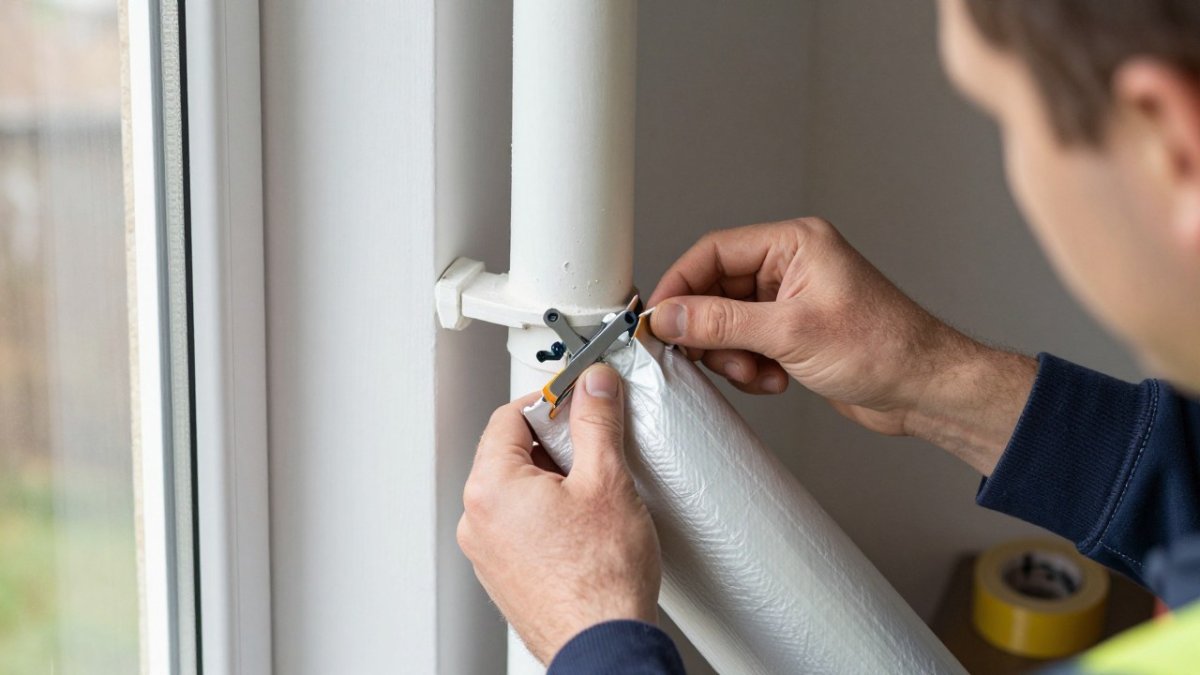
For pipework that freezes repeatedly, trace heating cable is one option to discuss with a qualified engineer. Its suitability depends on the route, and it needs a permanent power supply, which is why it suits the worst-affected routes rather than every job.
Match the approach to the route rather than treating every install the same:
- Short external run (under about a metre): waterproof lagging and a regular heating cycle is usually enough.
- Long external run: lagging alone is unlikely to hold in a sustained frost; combine it with trace heating or reroute the pipe internally.
- Pipe through a cold loft or garage: insulate it as if it were outdoors, because an unheated loft reaches outdoor temperatures.
- Pipe into a soakaway or drain: check the outlet is clear and not sitting in standing water, which can back up and freeze at the termination.
Watch out: lagging a pipe that already has a shallow fall or a sagging section will not fix the freeze risk, it will simply hide the standing water that causes it. If the pipe sags between clips, correct the fall before you insulate.
Match the insulation approach to how the pipe is routed and where it runs.
| Pipe route | What to do | Note |
|---|---|---|
| Short external run (under about a metre) | Waterproof lagging and a regular heating cycle | Usually enough |
| Long external run | Lagging plus trace heating, or reroute internally | Lagging alone unlikely to hold in sustained frost |
| Pipe through a cold loft or garage | Insulate it as if it were outdoors | Unheated loft reaches outdoor temperatures |
| Pipe into a soakaway or drain | Check the outlet is clear | Not sitting in standing water |
How to Thaw a Frozen Condensate Pipe Safely
Thawing is straightforward if you do it safely. The pipe is plastic and the water inside is near freezing, so heat must be gentle and gradual.
Follow these steps:
- Find the frozen section, usually at the outdoor end or a bend.
- Pour warm, not hot, water over the pipe.
- Work along the pipe from the boiler end outward.
- Repeat until water flows freely.
- Reset the boiler and check it runs.
Using warm water to clear the blockage
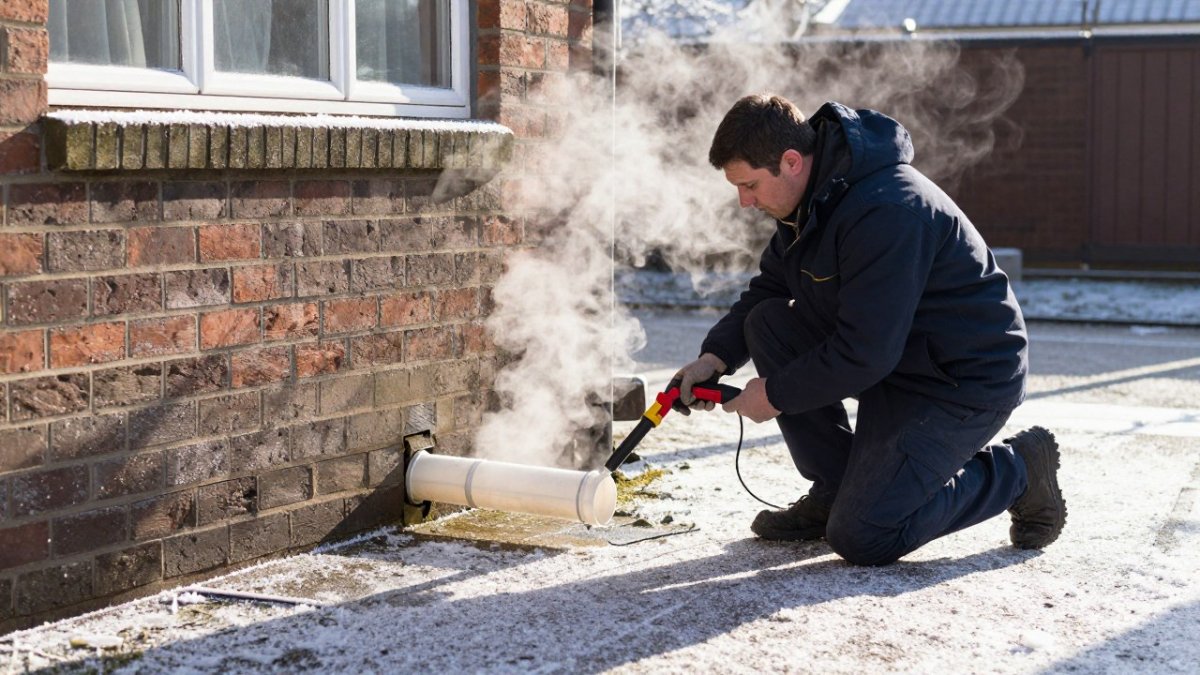
Use water from a kettle that has cooled for a few minutes. Hot water can crack the plastic or soften a joint. Never use a blowtorch, boiling water, or a naked flame on the pipe.
If thawing fails, or the pipe freezes again within days, the blockage needs proper attention. Our emergency plumbing team can clear it and check the route.
Prevention by Pipe Route and Property Layout
Where your pipe runs decides how you protect it. A pipe that discharges straight through a wall into a drain needs less work than one that runs several metres down an outside wall.
Match your approach to the route:
- Short external run: waterproof lagging and a regular heating cycle is usually enough.
- Long external run: lagging plus trace heating, or reroute the pipe internally.
- Pipe into a soakaway or drain: check the outlet is clear and not sitting in standing water.
- Pipe through a cold loft or garage: insulate it as if it were outdoors.
The simplest habit is to keep the heating on a low setting overnight in cold weather. A warm house keeps the pipe warm too.
Repeated freezing can also point to a boiler coming to the end of its life. Our guide on whether your gas boiler needs replacing helps you judge that.
When Prevention Fails: Safe Escalation to a Gas Safe Engineer
Some jobs are not for a homeowner with a kettle. If the pipe is inaccessible, the route is wrong, or the boiler keeps locking out, it is time for a qualified heating engineer.
Watch out: never open the boiler casing to reach a condensate connection. That work is gas work and must be done by a Gas Safe registered engineer.
You can verify any engineer’s registration through the Gas Safe Register before you book. It takes a minute and it is the only check that matters.
A boiler service before winter catches a badly routed pipe before it strands you in January.
Book a Gas Safe Check Before the Cold Sets In
The cold will come, and the pipes that freeze are almost always the ones nobody checked. A short inspection now costs far less than an emergency callout in the middle of a frost.
Major Heat is Gas Safe registered and offers boiler servicing, repairs and installations. Free quotes are available, and pricing is discussed when you request a quote.
Get started with Major Heat and keep your heating running through the coldest weeks.
Frequently Asked Questions
Should an external condensate pipe be insulated?
Yes. Any section of condensate pipe running outside the thermal envelope should be lagged with waterproof, weatherproof insulation. Standard foam lagging absorbs rainwater and then freezes, which makes things worse. Use closed-cell lagging rated for outdoor use, seal the joints with tape, and check the lagging each autumn before the first cold snap. If the pipe runs outside, insulation alone may not be enough in sustained cold, so ask a Gas Safe engineer what options suit your route.
Can I pour hot water over a frozen condensate pipe?
Pouring boiling water directly onto a frozen condensate pipe risks cracking the plastic or splashing back on you. Use warm, not boiling, water instead. Pour it slowly along the pipe, starting at the boiler end and working towards the outside, and use a jug or watering can rather than a kettle. Never use a naked flame, heat gun or hairdryer on the pipe. If warm water does not clear the blockage, or the pipe refreezes, call a Gas Safe registered engineer.
How can I tell if my condensate pipe is frozen?
The most common frozen condensate pipe symptoms are a boiler that has locked out with a fault code, gurgling or bubbling noises from the boiler, and no heating or hot water despite the thermostat calling for heat. Check the external pipe run for visible ice, frost build-up at the outlet, or a white plume of vapour escaping from a joint. If the pipe terminates in a drain or soakaway, look for ice blocking the end. A frozen pipe is one of the most frequent causes of a boiler stopping in winter.
When should I call a Gas Safe registered engineer about a frozen condensate pipe?
Call an engineer if warm water does not thaw the pipe within about 30 minutes, if the pipe has split or come apart at a joint, if the boiler keeps locking out after thawing, or if you cannot safely reach the external pipe. Any work on the boiler itself, including rerouting the condensate pipe, must be done by a Gas Safe registered engineer.
