
Last Updated: November 20, 2026
Quick Summary
Air source heat pumps are more efficient than boilers but electricity costs more per unit than gas, so whether you save depends on your system’s seasonal performance factor and your tariff. A well-insulated home with correctly sized radiators and a dedicated heat pump tariff will see the economics shift clearly in the heat pump’s favour.
- Air-to-water heat pumps heat radiators, underfloor loops and hot water cylinders, making them the standard boiler replacement.
- Installation cost depends on radiator upgrades, a new cylinder, pipework, electrical work and any grant deduction.
- Efficiency drops as outside air gets colder, but modern units keep running well below freezing.
- An annual service covers the refrigerant charge, fan, coils, condensate drain, controls and cylinder.
- Untick insulation, radiator sizing and outdoor siting boxes before committing to a system.
Table of Contents
- How Air Source Heat Pumps Work and What They Deliver
- Air Source Heat Pump Installation Cost and What Drives It
- Air Source Heat Pump Running Costs and Realistic Savings
- Air Source Heat Pump in Winter: Cold Weather Performance
- Air Source Heat Pump Maintenance, Noise and Lifespan
- Air Source Heat Pumps Versus Boilers and Other Low-Carbon Heating
- Is Your Home Suitable? A Room-by-Room Checklist
- Book a Heating Assessment Before You Commit
- Frequently Asked Questions
How Air Source Heat Pumps Work and What They Deliver
Weighing the pros and cons of air source heat pumps starts with understanding what the technology actually does. An air source heat pump is a heating system that extracts low-grade heat from outside air and upgrades it to warm your home and hot water. The honest answer depends on far more than a headline efficiency figure.
The principle is straightforward. A fan draws outside air across a heat exchanger filled with refrigerant, which absorbs heat even on a cold day. A compressor raises the temperature, and the heat is transferred to water for your radiators, underfloor heating or cylinder. Because the pump moves heat rather than generating it by burning fuel, it can deliver more heat energy than the electricity it consumes. That ratio is the coefficient of performance, and it is the single number that decides whether your bills fall or rise.
Air-to-water versus air-to-air systems
Air-to-water heat pumps heat water for radiators, underfloor loops and hot water cylinders. They are the standard choice for replacing a gas or oil boiler in a wet heating system.
Air-to-air heat pumps warm the air directly and cannot supply hot water. They suit open-plan spaces or homes with existing ductwork, but they are a different proposition from a boiler swap. Most homeowners replacing a conventional heating system want air-to-water, so that is what the rest of this guide covers.
Air Source Heat Pump Installation Cost and What Drives It
Installation cost depends on the work your home needs, not just the unit itself. A straightforward swap in a well-insulated property with suitable radiators costs far less than a full system redesign with new pipework and a larger cylinder.
The main cost drivers:
- Heat pump unit and size: a larger output unit costs more.
- Radiator upgrades: existing radiators often need to be larger to run at lower flow temperatures.
- Hot water cylinder: many homes need a new or bigger cylinder.
- Pipework and insulation: undersized pipes may need replacing.
- Electrical work: the pump needs a suitable supply, sometimes a new circuit.
- Grant deduction: the Boiler Upgrade Scheme can reduce the net figure.
For a full breakdown of what switching actually costs, read our guide to the cost of switching from gas to heat pump.
Air Source Heat Pump Running Costs and Realistic Savings
Running costs are where the argument gets interesting, and where most marketing claims fall short. A heat pump is more efficient than a boiler, but electricity costs more per unit than gas. Whether you save depends on the gap between those two prices and how well your system performs. That is why we never promise a fixed saving, and why any guide that quotes a single annual figure without asking about your home, your tariff and your existing fuel is guessing.
The two numbers that decide your bill
Your running cost comes down to two things: how much heat your home loses, and what you pay per unit of delivered heat. A heat pump’s seasonal performance factor (SPF) is the real-world version of the laboratory coefficient of performance.
The catch is the price ratio. Gas is usually cheaper per kWh than electricity, so a heat pump needs an SPF high enough to overcome that gap. On a standard variable electricity tariff, the maths often lands close to parity with gas. On a dedicated heat pump tariff, which typically offers a lower rate for a defined number of hours, often overnight, the economics shift clearly in the heat pump’s favour. The tariff is the lever most homeowners overlook, and it matters more than the headline efficiency of the unit.
What a realistic household looks like
Now take a poorly insulated home with the same heat demand but an SPF of 2.2 because the system is oversized, radiators are undersized and flow temperatures are high. Electricity use rises to about 5,450 kWh, and even on a good tariff the running cost climbs towards £820. This is the pattern behind most complaints: the technology is fine, but the design and the tariff are not.
Where the savings actually come from
Savings depend on the home, the system design and the electricity tariff, so the running cost differs from one property to the next.
It is also worth separating heating from hot water. Hot water demand is steady year-round and less affected by outdoor temperature, so a well-sized cylinder with a good immersion or heat-pump coil matters. Oversized cylinders that run legionella cycles on peak-rate electricity quietly erode savings.
Watch out: a common mistake is comparing a heat pump quote against a gas bill that includes cooking and hot water, then assuming the heat pump will cover all of it.
For a full breakdown of what switching actually costs, read our guide to the cost of switching from gas to heat pump. Our guide to reducing electricity usage at home covers the practical steps that make the biggest difference to the rest of your bill.
Air Source Heat Pump in Winter: Cold Weather Performance
An air source heat pump in winter still works in low temperatures, but efficiency drops as the outside air gets colder. This is normal and expected. The system is sized to meet your home’s heat loss on the coldest days, and modern units keep running well below freezing. Because a heat pump in cold climates can still provide reliable warmth as temperatures fall, lower efficiency on the coldest days need not mean the system will stop working.
The practical concerns are defrost cycles, which briefly interrupt heating to clear ice from the outdoor unit, and ensuring the unit is not sited where it recirculates its own cold air. A correctly sized system with a well-insulated home copes with a British winter without drama. The problems usually trace back to design and installation, not the technology itself.
Air Source Heat Pump Maintenance, Noise and Lifespan
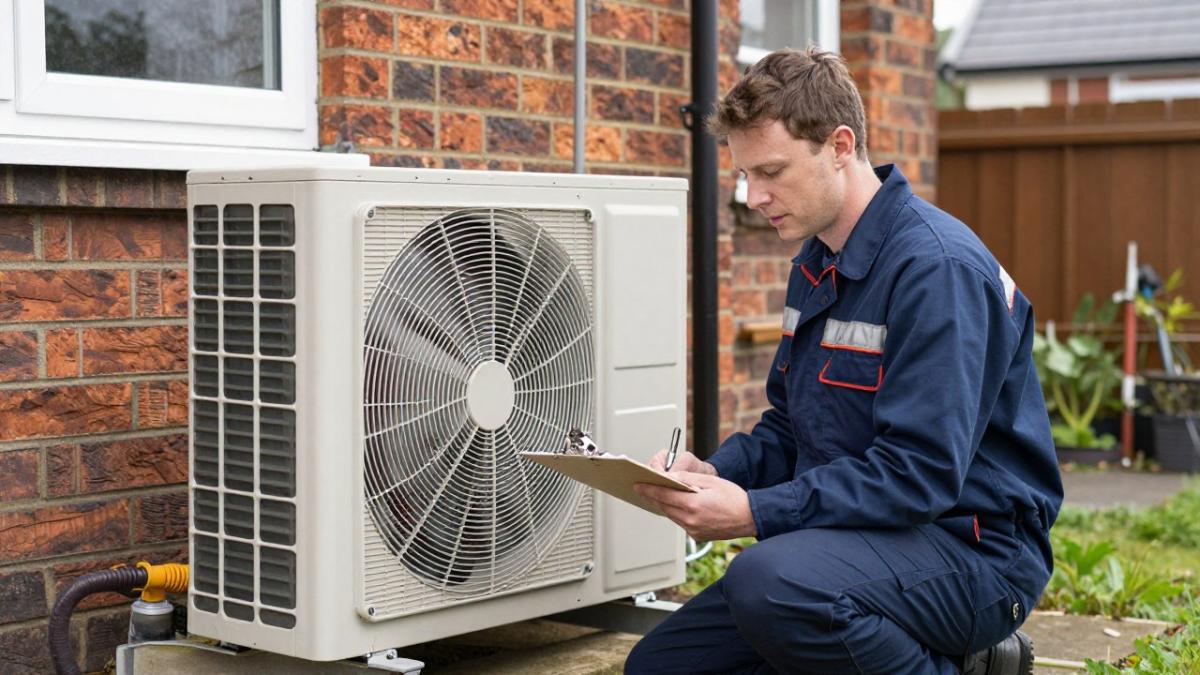
Maintenance is modest but not optional. An annual service keeps efficiency up and catches small faults before they become expensive ones. Lifespan depends on installation quality and maintenance. A service typically covers the refrigerant charge, the fan and coils, the condensate drain, the controls and the cylinder, and most practitioners recommend booking it in early autumn before the heating season starts.
Noise: what to expect and how to reduce it
Noise is a fair concern, and one the industry has improved on. The perceived noise at a neighbour’s window is much lower because sound falls away with distance, but siting still matters enormously. Keep the outdoor unit away from bedroom windows, avoid corners where sound reflects, and do not site it directly against a boundary where a neighbour’s window or patio sits close by.
Planning rules on siting and noise can apply to air source heat pump installations, so check the position of the unit before you commit.
Practical ways to reduce disturbance include anti-vibration mounts, an acoustic enclosure or plant screen, keeping the unit off a wall shared with a bedroom, and ensuring the fan is not cycling noisily because the system is oversized. A well-designed system runs at low flow temperatures for longer, which is usually quieter than a system that short-cycles at high output.
Lifespan and what shortens it
The real lifespan depends on installation quality and water treatment. Poor water quality, incorrect refrigerant charge, undersized pipework and a system that constantly runs at high flow temperatures all shorten component life. A magnetic filter and correct inhibitor are cheap insurance. The outdoor unit also benefits from being kept clear of leaves and snow, and from a service that checks the fan bearings before they fail.
Watch out: the most common complaint we hear is not about the pump but about the controls. Complex settings and poorly explained timers leave homeowners running the system inefficiently. Ask for a proper handover, and ask the installer to leave the flow temperature and schedule set for your home rather than at factory defaults.
Air Source Heat Pumps Versus Boilers and Other Low-Carbon Heating
Against other low-carbon options, the picture varies:
| System | Upfront cost | Running cost | Best for |
|---|---|---|---|
| Air source heat pump | Higher | Lower on a good tariff | Well-insulated homes with radiators |
| Gas boiler | Lower | Tied to gas prices | Homes not ready for a heat pump |
| Electric boiler | Lower | Highest | Flats or homes with no outdoor space |
| Oil or LPG | Varies | High and volatile | Off-gas properties |
For a side-by-side look at all the options, see our comparison of alternative heating to gas.
Is Your Home Suitable? A Room-by-Room Checklist
Use this checklist before you commit:
- Loft and walls: is insulation to a reasonable standard?
- Radiators: are they large enough to heat each room at lower flow temperatures?
- Outdoor space: is there a suitable spot for the outdoor unit, away from windows and boundaries?
- Hot water cylinder: is there room for a cylinder if you do not have one?
- Electrics: is the consumer unit and supply adequate?
- Windows and draughts: are these addressed before sizing the system?
If several boxes are unticked, the priority is fabric improvements first, then a properly sized system.
Book a Heating Assessment Before You Commit
The pros and cons of air source heat pumps are real on both sides, and no generic guide can tell you which way your home will fall. Before booking, it is worth checking who qualifies for the Boiler Upgrade Scheme, as eligibility affects the net cost significantly.
Our Gas Safe registered engineers provide free quotes, and we will advise you on whether a heat pump suits your property.
Get started with Major Heat and book a heating systems assessment with engineers who will give you a straight answer.
The decision is rarely as simple as the sales pitch suggests. If you want a clear view of what your home actually needs, our team is ready to help.
Frequently Asked Questions
What are the main disadvantages of an air source heat pump?
The main drawbacks are upfront cost, outdoor space requirements and noise. Radiators may also need upsizing, and the home needs decent insulation for the system to perform well.
Are air source heat pumps cheaper to run than gas boilers?
It depends on your electricity tariff and how well the system is set up. A heat pump moves heat rather than burning fuel, so it can deliver more heat per unit of electricity than a boiler does per unit of gas. But electricity is priced higher per kWh than gas, so the running costs of air source heat pumps hinge on the tariff you are on and the seasonal performance of the installation. A well-matched system on a suitable tariff is where the savings come from.
Do air source heat pumps work well in cold weather?
Yes, they are designed to run through a UK winter. Output and efficiency drop as the outdoor temperature falls, which is why correct sizing and good insulation matter. A system sized for the coldest days will still heat the home, but it will work harder and use more electricity during cold spells. Ask your installer for the declared capacity at low outdoor temperatures so you know what to expect in January rather than July.
How much maintenance does an air source heat pump need?
Plan for an annual service, similar to a boiler service. Between services, keep the outdoor unit clear and check that condensate can drain freely in freezing weather. Book servicing before winter so any issue is found while the system is still working.
