
Last Updated: 4 November 2026
Quick Summary
To document gas appliance repairs, keep a dated repair log entry for each job recording the property, appliance details, fault, engineer’s Gas Safe licence number, work done, parts fitted, post-repair safety check result and invoice reference. File the engineer’s report and invoice with it the same day, and cross-reference the entry to your annual Landlord Gas Safety Record.
- A repair record and the annual safety check certificate are separate documents, and neither replaces the other.
- Record the tenant’s report the moment it arrives, including the date, time and their exact words.
- For a suspected gas leak, tenants should call the National Gas Emergency Service on 0800 111 999.
- Keep the Landlord Gas Safety Record for at least two years and give copies to tenants within 28 days.
- Name digital files by property and date so records stay searchable as repairs accumulate.
Table of Contents
- Why Every Gas Appliance Repair Needs a Paper Trail
- What the Law Requires: Landlord Gas Safety Responsibilities
- Your Gas Appliance Repair Log Template
- Reading a Gas Appliance Repair Report
- The Landlord Gas Safety Record Explained
- Filing the Gas Engineer Invoice for Landlords
- Step-by-Step: Handling a Faulty or Unsafe Appliance
- Stage 1: Receive and record the tenant’s report
- Stage 2: Make the appliance safe
- Stage 3: Arrange a Gas Safe registered engineer
- Stage 4: Capture the engineer’s findings
- Stage 5: Act on the outcome and record the decision
- Stage 6: Confirm resolution with the tenant
- Stage 7: Update the repair log and cross-reference the annual check
- How Long to Keep Repair Records and Where to Store Them
- Frequently Asked Questions
Why Every Gas Appliance Repair Needs a Paper Trail
A missing gas safety record is one of the fastest ways for a landlord to end up in court. If you want to understand the legal consequences of missing gas safety records, they explain why the paper trail matters.
Documentation is your proof that you met your duties as a landlord.
Here is the tension most landlords miss. A repair record and an annual safety check are not the same thing.
The stakes are real. You can read the official guidance on landlord gas safety duties to see the full picture.
What the Law Requires: Landlord Gas Safety Responsibilities
Landlords must arrange an annual gas safety check on gas appliances and flues in a rented property, carried out by a Gas Safe registered engineer (Gas safety – landlords and letting agents).
Those are the headline duties. For a deeper explanation of your overall duties, see landlord responsibilities for gas appliance maintenance. The Gas Safe Register’s landlord guidance sets out what counts as a valid check and who is qualified to do it.
A common mistake is thinking the annual certificate covers repairs. It does not. The certificate is a once-a-year snapshot; repairs happen in between, and each needs its own trail.
- Annual check: proves the appliance was safe on one date
- Repair record: proves you fixed a fault and when
- Both matter, and neither replaces the other
Your Gas Appliance Repair Log Template
A repair log records every gas appliance repair at a property, in date order: what went wrong, who fixed it, and what evidence you hold. Keep it simple and consistent.
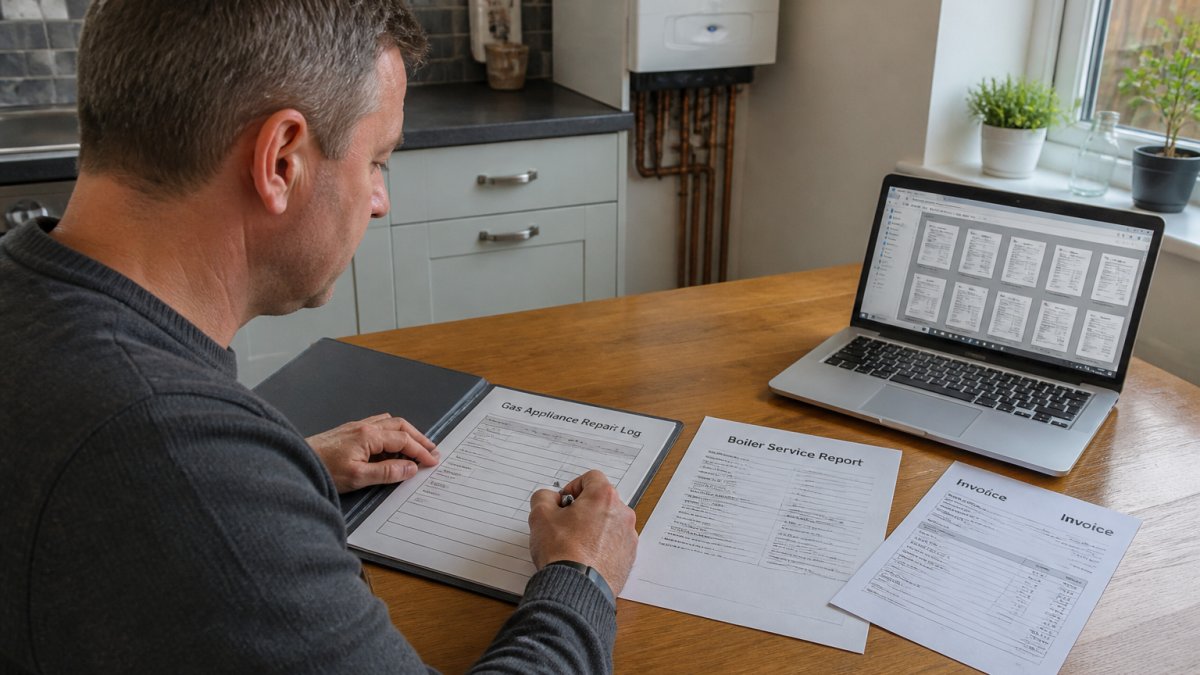
Fields to Capture at Every Visit
Every entry needs the same core fields. Copy this list and use it for each repair:
- Property address and appliance location
- Appliance make, model, and serial number
- Date of the fault report and date of repair
Fill it in at the time, not weeks later. Memory fades, and a half-remembered entry is worse than none.
Every repair entry should capture the same core fields, so here they are in one place.
| Field | What to record |
|---|---|
| Property and appliance | Property address and appliance location |
| Appliance identity | Make, model and serial number |
| Dates | Date of fault report and date of repair |
| Engineer | Name and Gas Safe licence number |
| Work | Fault found and work carried out |
| Parts and advice | Parts fitted and any advisory notes |
| Safety result | Safety check result after the repair |
| Payment and filing | Invoice reference, amount paid, date filed |
Reading a Gas Appliance Repair Report
A gas appliance repair report is the engineer’s written account of the fault, the work done, and the safety status of the appliance after the repair.
Read it before you file it. Our guide on how to verify Gas Safe registration walks you through it.
Watch out: a report that says “repaired” with no fault description is not worth much.
The Landlord Gas Safety Record Explained
The Landlord Gas Safety Record is the formal certificate issued after the annual check, not after a repair.
This is where confusion bites. The certificate proves an annual check took place; the repair log proves you acted on faults between checks.
Keep them separate but cross-referenced. Note the certificate date in your repair log, and note any repairs in the following year’s check.
Filing the Gas Engineer Invoice for Landlords
A gas engineer invoice for landlords is your proof of payment and your record of the work billed. It should match the repair report line for line: same date, same appliance, same work described.
File it the same day it arrives, attached to the repair log entry. The invoice is often the only dated document proving a repair happened, so it carries real weight.
- Match invoice date to repair date
- Check the work described matches the report
- Store the invoice with the log, not alone
Step-by-Step: Handling a Faulty or Unsafe Appliance
When an appliance is faulty or unsafe, the paperwork you create at each stage proves you acted reasonably. Work through this workflow in order and you will have a complete record by the time the job closes. If the check has failed, our guide on what to do if a gas safety check fails covers your next steps.
Stage 1: Receive and record the tenant’s report
Log the report the moment it arrives, even if it is a voicemail at 9pm. Record the date and time, the tenant’s name, the appliance and its location, and the tenant’s exact words.
Watch out: a verbal report that is never written down is the weakest link in most repair disputes. A short email or text back to the tenant confirming what they reported creates a dated, two-sided record at no cost.
Stage 2: Make the appliance safe
For a suspected gas leak, tell the tenant to turn off the gas at the meter if they can safely reach it, open windows and doors, avoid operating electrical switches, and leave the property.
Record the isolation in writing: date and time, who isolated the appliance, how (for example, gas supply capped or appliance disconnected), and who authorised it.
Stage 3: Arrange a Gas Safe registered engineer
Book an engineer who is qualified for the type of appliance and work involved. Confirm their Gas Safe licence number before attendance and check it against the register. Record the booking date, the engineer’s name and licence number, and the attendance date. If the engineer cannot attend immediately, record the interim safety measures you agreed with the tenant.
Stage 4: Capture the engineer’s findings
File the job sheet or repair report the same day. It should name the appliance, describe the fault, list parts fitted, state the post-repair safety check result, and confirm whether the appliance is safe to return to use. Keep the original or a clear scan of any unsafe appliance or warning notice, and note advisory comments such as a recommendation to replace, even if you do not act on them yet.
Stage 5: Act on the outcome and record the decision
If the appliance is unsafe and cannot be repaired, record your decision to isolate or replace it, the date, and who made the decision. If the engineer recommends further work, log the recommendation, your response and the date you booked the follow-up. A short written note explaining why you did or did not act on advice is far stronger than silence if an inspector later asks.
Stage 6: Confirm resolution with the tenant
Write to the tenant confirming what was found, what was done, when the appliance was returned to safe use, and any remaining actions. Keep a copy of that communication with the repair record. This closes the loop and gives you a dated confirmation that the tenant was informed.
Stage 7: Update the repair log and cross-reference the annual check
Add the entry to your repair log, attach the invoice, job sheet and tenant communications, and note the date of the next annual gas safety check. Flag repairs that happened between checks so the next engineer can see the history.
Every rented property should also have a working carbon monoxide alarm and a written gas leak response plan that tenants have seen.
How Long to Keep Repair Records and Where to Store Them
Retention and storage are where good documentation quietly fails. The law sets a minimum, but the documents that protect you go beyond the certificate, and storage determines whether you can produce them under pressure.
What to keep after every repair
Treat each repair as a small evidence pack. The pack should contain:
- The tenant’s original report, in whatever form it arrived
- The engineer’s job sheet or repair report, including the fault description and post-repair safety result
- Any unsafe appliance or warning notice issued
Keep the pack together. An invoice in one folder and a job sheet in another is the most common reason landlords cannot reconstruct a repair when asked.
Repair records versus the annual gas safety check
These are separate obligations and separate documents. The annual check produces the Landlord Gas Safety Record, kept for at least two years and given to tenants within 28 days. Repair records are not a substitute, and the annual record does not prove you fixed a fault in between. Keep both and cross-reference them: note the certificate date in the repair log, and note repairs in the following year’s check history.
Retention periods in practice
Keep repair records for a period that covers disputes and insurance claims, which can surface well after the event. Check your insurer’s requirements, as some policies set their own evidence expectations.
Digital storage that actually works
Paper folders get lost, damaged or left in a drawer at the wrong property. A simple digital system is more reliable if you follow four rules:
- Store files in a structured folder tree: property, then year, then repair date and appliance.
- Use a consistent naming convention, for example the address, appliance and date, so files sort predictably.
- Back up to a second location, whether that is cloud storage or an external drive kept separately.
- Control access so that anyone who needs to produce a record, such as a letting agent or a stand-in, can find it without hunting through personal email.
Scan paper documents the day they arrive and file the scan with the pack. Keep the original only where it carries a signature or a notice that may need to be produced physically.
Watch out: a folder named only by the engineer’s name or the month is almost impossible to search later.
Set reminders so records stay current
Storage is only half the job. Put the next annual check date in your calendar as soon as the current certificate arrives, and add a reminder to review the repair log before each check. See our guide on preparing rental properties for annual gas inspections for how to organise records ahead of the visit.
Frequently Asked Questions
What records should a landlord keep after a gas appliance repair?
Keep the engineer’s repair report, the invoice, and any photographs of the fault and completed work. Record the appliance details, Gas Safe registration number, date of the repair and what was replaced. File these alongside your landlord gas safety record so the full history of the appliance sits in one place. If the repair followed a safety warning, keep the follow-up inspection note too, as it proves the fault was resolved.
Does a gas appliance repair need to be recorded on a gas safety certificate?
No. A repair record and a landlord gas safety record serve different purposes. The annual gas safety check records the condition of appliances, flues and pipework on the day of inspection. A repair report documents work carried out between checks. Keep both, because the certificate shows compliance while the repair log shows the maintenance history if a tenant or insurer asks questions later.
Can a landlord use an invoice as proof of a gas appliance repair?
An invoice alone is weak proof because it usually shows only a total and a date. Use it as a supporting document alongside the engineer’s report, which should list the fault found, parts fitted and safety checks completed. Ask your engineer to note the Gas Safe licence number on the invoice. Together, the two documents give a clear gas appliance repair report that stands up to scrutiny.
How long should landlords keep gas appliance repair records?
Keep repair records for at least two years, and longer if the appliance is still in the property. Many landlords retain the full history for the life of the boiler plus two years, since a future buyer or insurer may ask for it. Store digital copies in a dated folder and keep paper originals with the tenancy file so nothing is lost when a tenant moves out.
Gas appliance repairs for landlords come down to one habit: record it the day it happens. If you would rather leave the paperwork to the experts, Major Heat can help. Our Gas Safe registered engineers handle boiler installations, servicing, and repairs, with free quotes and transparent pricing. We also support landlords with compliance checks. Get started with Major Heat and keep your gas records in safe hands.
